STORIES OF HOUSES feature examples of dwellings from which we can all learn - both the clients during their contemplation about building a house, and the architects to understand and evaluate the life of the clients.

How can an architect design a house for his older sister who has just become a widow? What can an architect offer when his client, who is confined to a wheelchair, asks for a complex design that will become his world? And when art lovers offer total freedom for the design of their house? How is one to explain that the neighbours once shot at the house of the architect who now has acclaimed international prestige?
This series of articles tries to give answers to questions concerning intimacies and origins of important international houses. They try to fill the gap left by so many History of Architecture books which, when neglecting these extreme personal sources, forget the multidisciplinary character of architecture. The houses analysed have been selected for their good architecture and for having been designed by a famous architect. But more than that, there is also an indispensable ingredient of having clients tell a passionate story that generates the project. Stories of Houses include information about the clients, their requests and needs, without which one cannot begin to understand the final result.

Contemporary houses
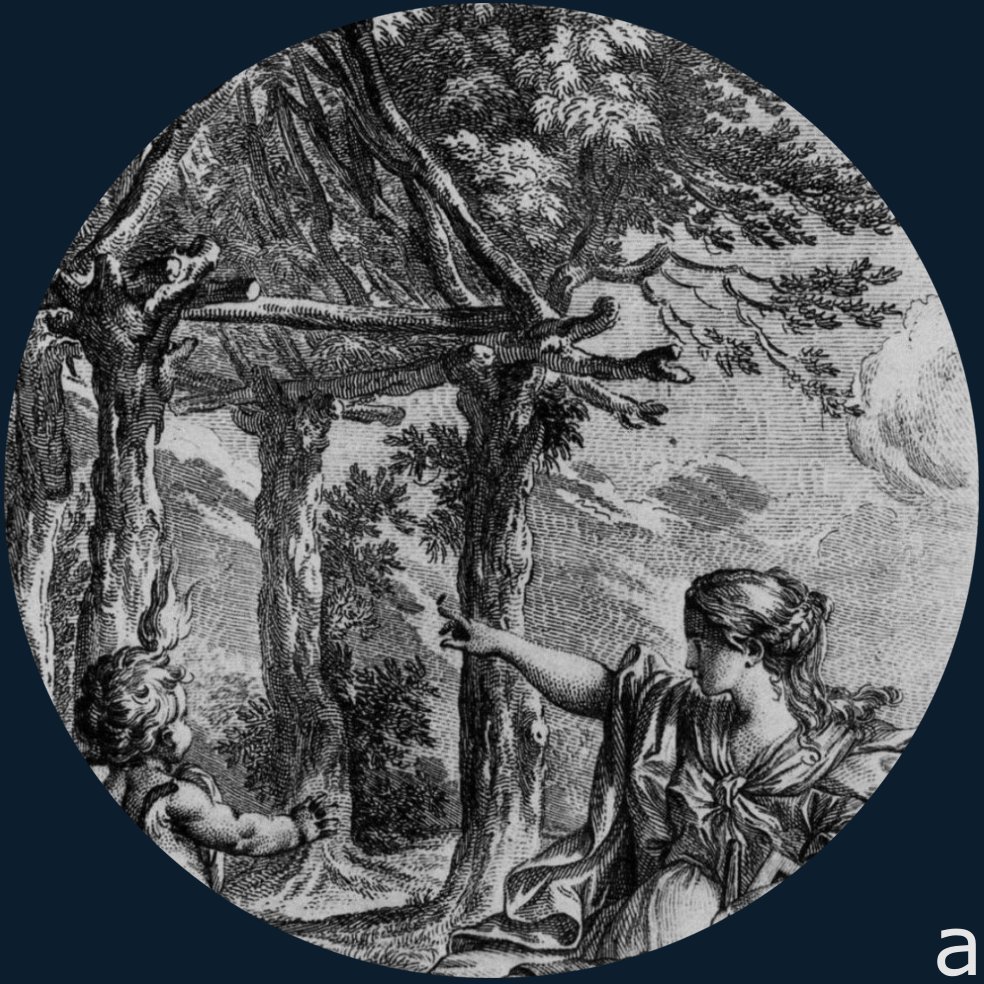
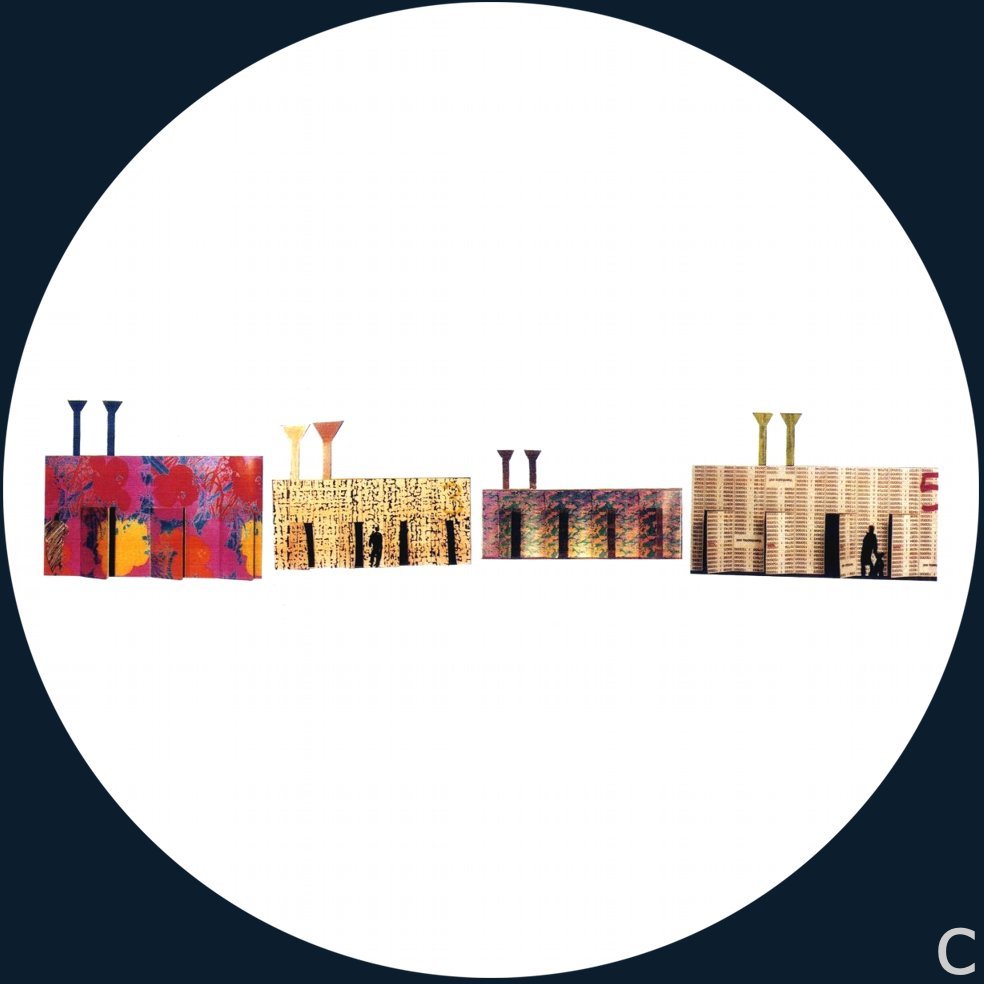
From Laugier's hut, which illustrates primitive architecture, to the houses by such architects as Ábalos and Herreros which are based on the idea behind the Swatch watches, through to the House of the Future, a project by the couple Alison and Peter Smithson, the study of housing has been linked to the time in which it was built. Beyond styles or fashions, Stories of Houses deals with feelings and passions which help to establish an analysis detached from the time to which it belongs. They are examples of architecture which will always be up-to-date, bearing in mind that they are concerned with personal feelings with which we all identify.
The elaboration of the program for the dwelling, which is articulated by the clients, is a process that is later reversed when the house moulds the life of its inhabitants. The furniture, memories, inherited objects and collections are all symbols of what we are and what we want to be. One could argue that if the facades of the houses are the interior of the city, then the interior of the houses are the exterior of their inhabitants. Thus, the history of the dwelling derives from the plurality of society in which it is built, from the architect's education and imagination and the life of the user. In short, the articles are concerned with recovering an intense connection between the client and the architect.
The published material has the rigour of having been revised and accepted by the architects of the houses. The articles are about recently built houses - although some now are demolished - and in only one case, there will be an un-built project. This is by the Spanish architect Enric Miralles, whose recent death did not allow him to complete it. To him we dedicate these articles.

Captions for illustrations
A. Marc-Antoine Laugier, The primitive hut, in Essay on Architecture (Paris 1753).
B. The House of the Future by Alison and Peter Smithson was presented in the annual exhibition Ideal House organised in 1956 by the newspaper The Daily Mail in London. It was a mass produced house that anticipated what would become available in 25 years time.
C. The AH houses by the architects Iñaki Ábalos and Juan Herreros (1994) react to the conventional dwelling, changing their images according to the environment in which they are placed.
D. The facades of the houses are the interior of the city. View of Reykjavik
E. Town house of the architect John Soane, built in London at the beginning of the nineteenth-century. Some of its interior space exteriorises its inhabitants.

SMALL HOUSE FOR A KOLONIHAVEN, BY ENRIC MIRALLES


In 1996 the Spanish architect Enric Miralles was asked to design a little wooden house near Copenhagen, a project that he elaborated with his wife, Benedetta Tagliabue. The result was a house that came to reflect a family lifetime.
The present article is the only one of the collection STORIES OF HOUSES that deals with a project that has not been built. Although the recent death from cancer did not allow the young Miralles to conclude the house, the value of the project goes beyond its materiality.

Building time
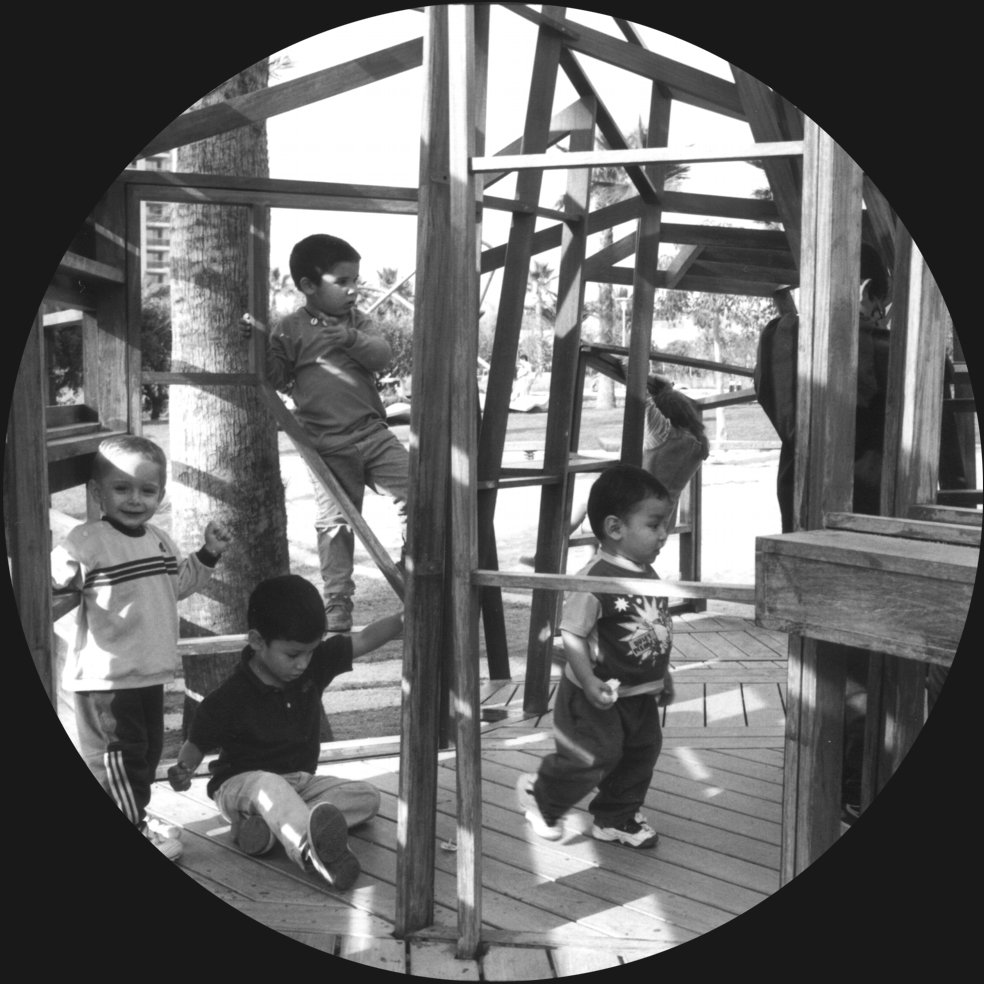
There still continues an old tradition in Denmark of building minute houses, or allotments, in the market gardens at the outskirts of towns. These housing developments are called Kolonihaven and their sole function is to shelter their owners from the cold and rain when spending time close to nature. The new Kolonihaven near Copenhagen groups a diversity of small houses between cherry trees. They are works of fourteen renowned architects who where invited to build distinctive retreats with the only condition not to surpass 6 m2 of ground.
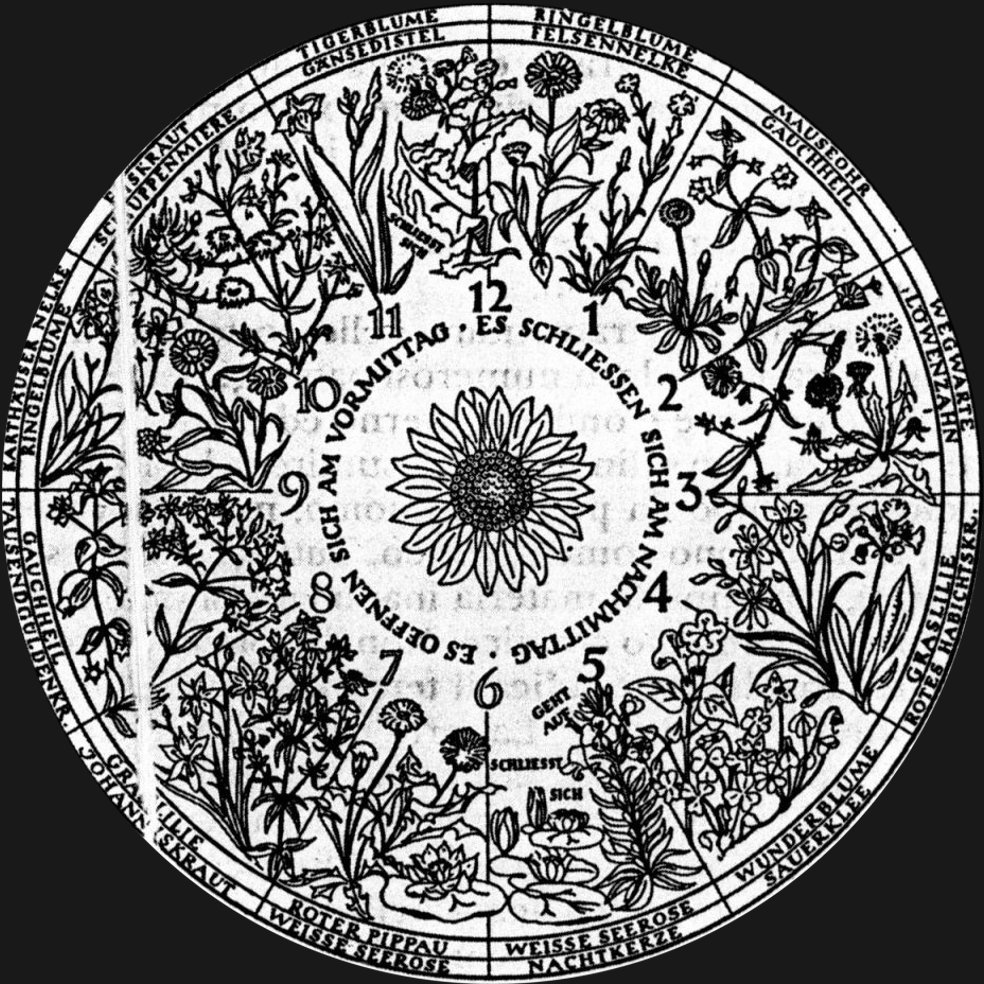
The couple Miralles and Tagliabue generated their project from their interest in recording the passage of time. From that starting point, the architects explained, "the house becomes a calendar". It is a place to feel time passing when looking at nature, while the parents talk around a table and the children play their games. Along with the drawings and models, the architects illustrated their explanations bringing a German almanac that shows the flowers of the different months of the year, with their timing of opening and closing each day: chicory in the mornings of February, water-lilies in those of June, marigolds during the days of September and opened carnations in all December.
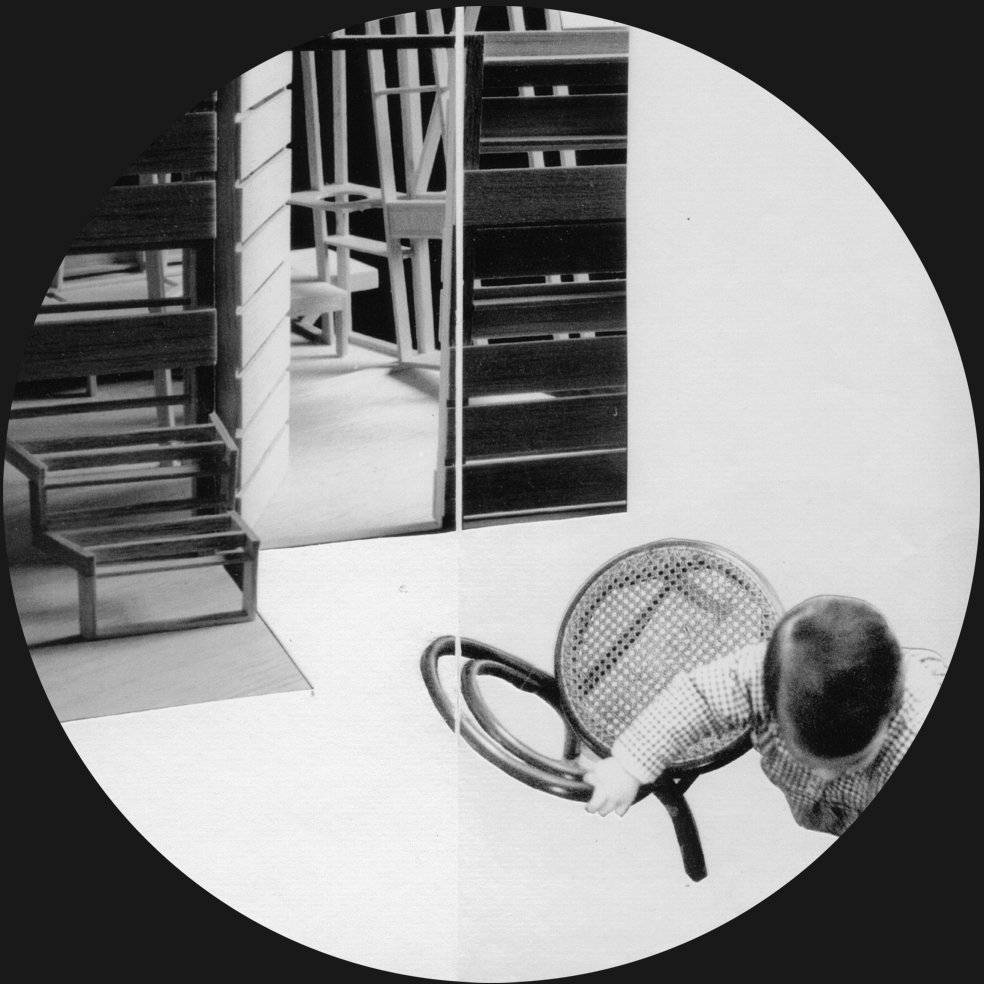
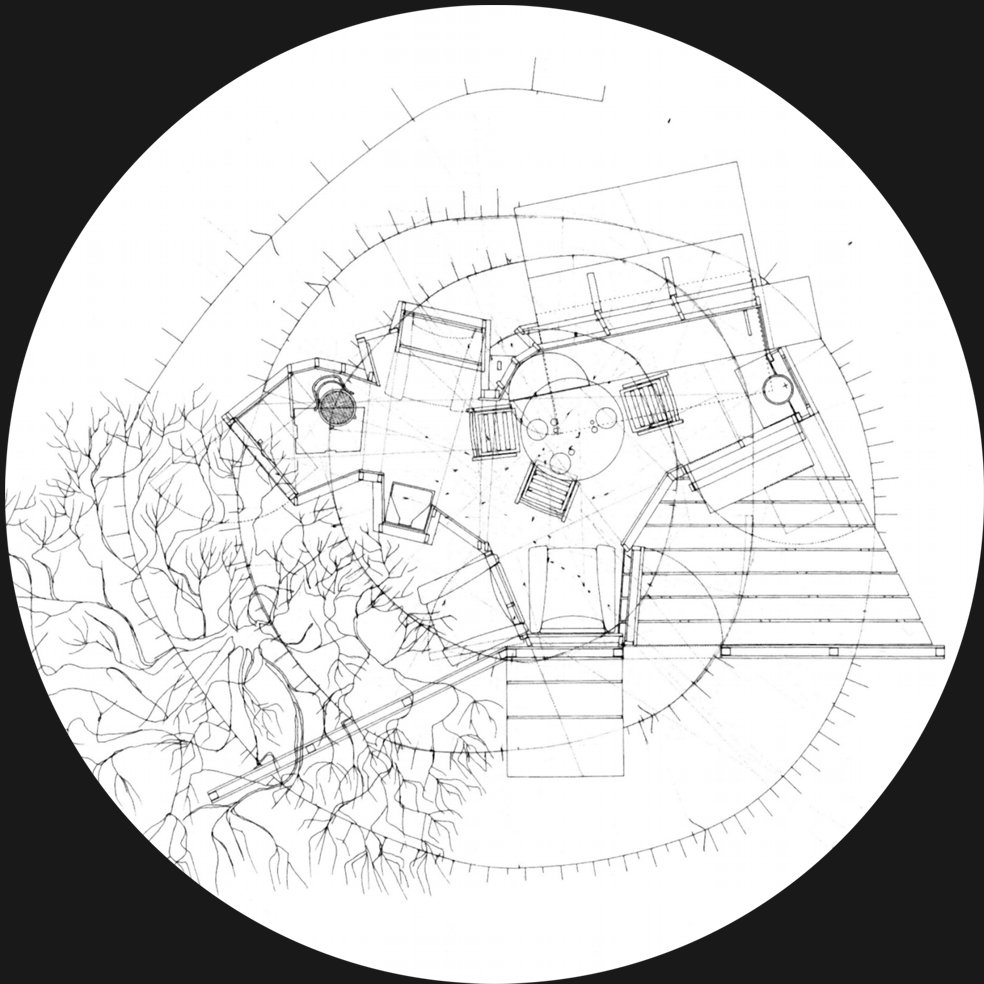
The passage of time is also recorded while sketching the plan of the little house. Enric and Benedetta gave their small daughter a miniature chair and she started to play with it, taking her first steps with it and moving it. Like if trying to draw these movements on the floor, the parents generated the plan of the house. From its limits a timber framework was brought to life which forms the volumes which embraces, exactly like a dress, the movement of the girl with her chair and the adults sitting around the table.
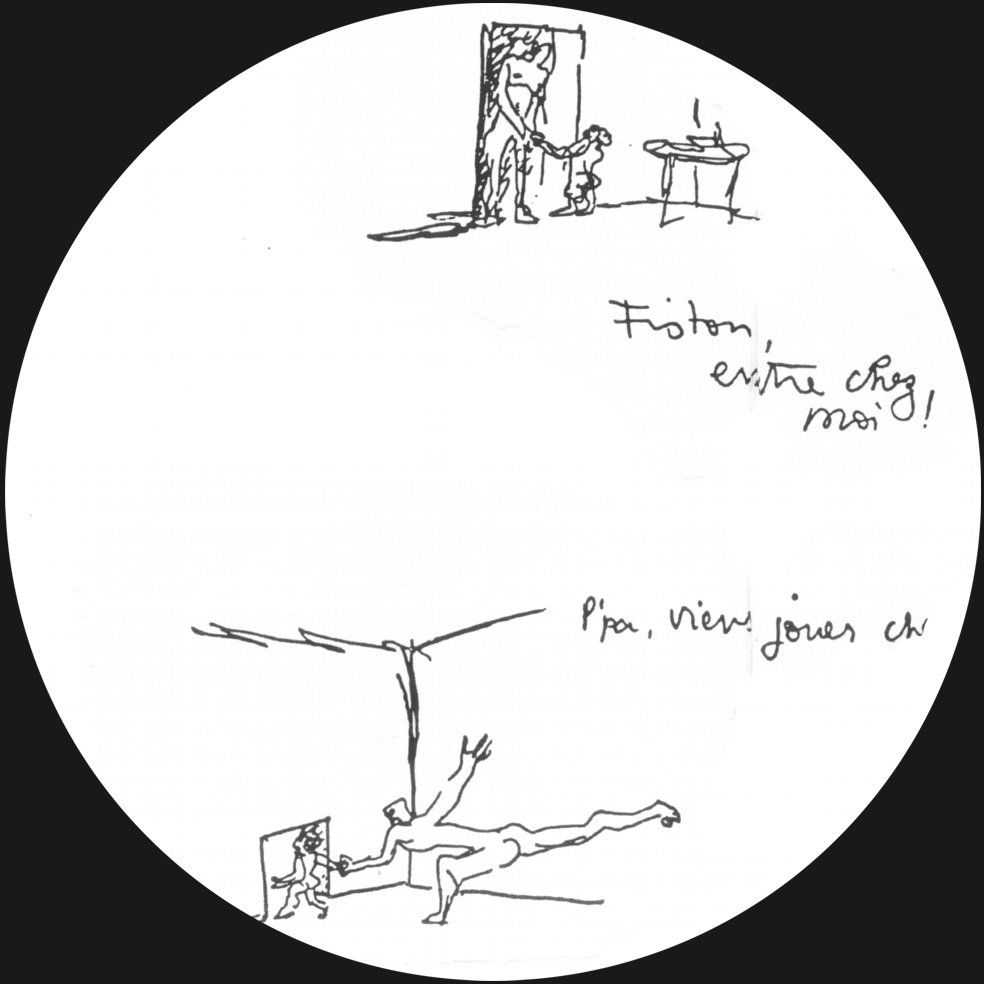
At this point in the design process, the architects brought an old drawing by the architect Le Corbusier where a girl asks an adult to play with her, inviting him to enter a house through a small door to the world at her size. The house in Kolonihaven varies in height. It has a very low ceiling in the children's room but becomes higher by the sitting room for adults. Seen through its section, the house captures this passage of time - the house grows with the inhabitant, from being a child to become an adult.

1955-2000
The theme of this project for a tiny shelter lies in dealing with the passage of time, with life itself. Its function is precisely that, and nothing more. If the saying is true that an architect can be measured from his project for a single house, then in designing a small wooden house for a Kolonihaven one could measure the architect as a person. In such a project, the architect is commissioned to describe his vision of life, to see time pass by.
Because of this reason, perhaps, Enric Miralles included his little daughter in the development of the house in Kolonihaven and acknowledged her as a collaborator, naming her in the list of the project team. It was a confusion of his private and professional lives, something that Enric had always done.

Captions for illustrations
1. Enric Miralles (1955-2000) and Benedetta Tagliabue (n. 1963), architects. (Photo:Giovanni Zanzi)
2. "The house becomes a calendar."
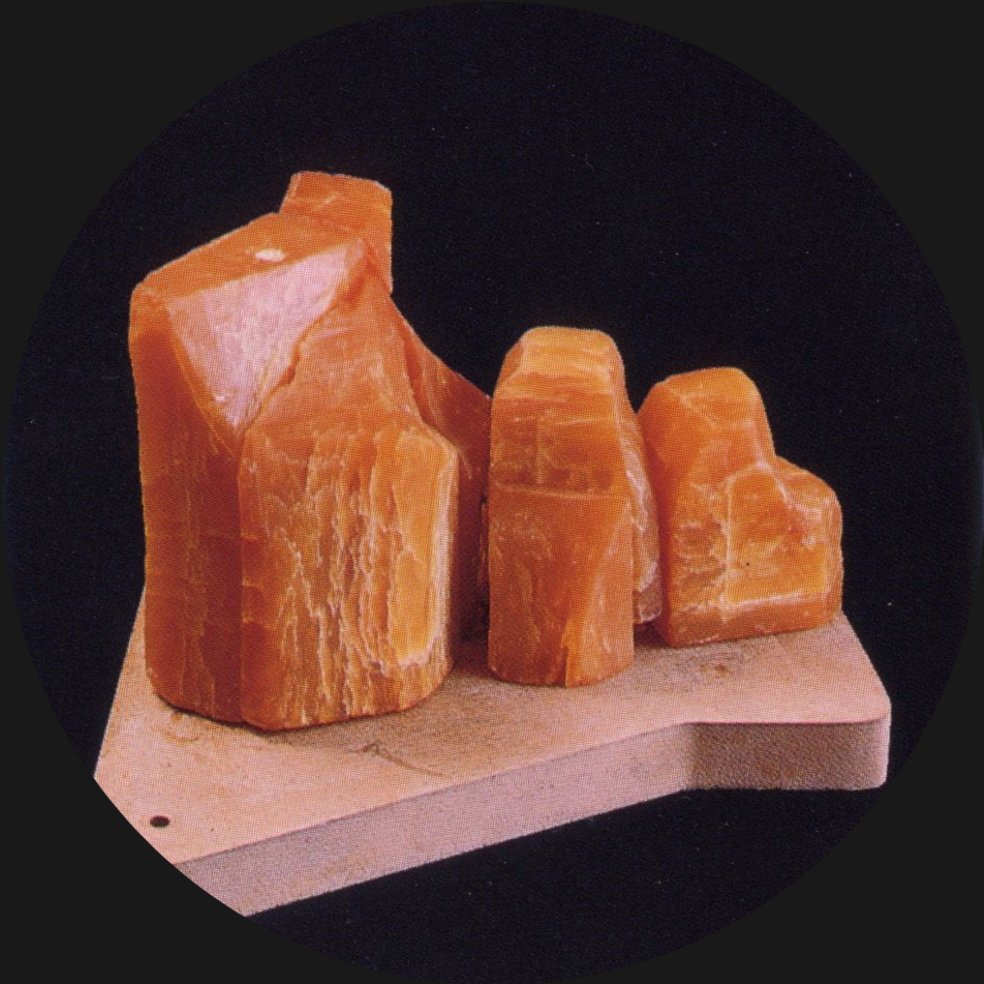
3. Enric always liked to explain his projects with an allegorical tale. Here, the Kolonihaven house "is a miniature stone in a bonsai landscape."
4. A little girl taking her first steps with a help of a small chair.
5. The tiny house has two entrances; one of which is a miniature door for the child.
6. A model in soap.
7. The house was like a dress that embraced both the movements of the child and the parents.
Photo: Alex Gaultier

MIRANDA SANTOS HOUSE BY ÁLVARO SIZA


At the beginning of the 1960's, the Portuguese architect, Álvaro Siza, designed a house for a writer in Matosinhos, Porto. Since then, there have been several changes in its ownership but Siza has continued to be the architect throughout and has been in charge of all its alterations, additions and new furniture. Now, due to external circumstances, the house fulfils all the requirements to be a museum of the architect.

The owners of the house
The writer Luisa Ferreira da Costa commissioned the young Álvaro Siza in 1962 to design a house in a dense neighbourhood of small plots. Costa asked for privacy and seclusion, and requested low, indirect light suitable for her writing. Siza responded by providing a two-storey house with skylights to create diffuse overhead light and small windows in the elevations to simply provide views of orientation and reference. He made use of the architectural vernacular, using mono pitched tiled roofs and plastered structural granite walls. This produced simplicity of volumes, a quality of composition reinforced by meticulous constructional details with openings framed in thick timbers, untreated to retain their natural colour.
The house changed ownership in 1987. Its new proprietor, Miranda Dos Santos, commissioned Siza to make alterations which consisted of enlarging existing windows and making new ones as a reaction against the new owner's perception of the dim light of the skylights. These new openings were detailed differently from the original construction. It was as if Siza was marking his own evolution by adding new materials: the new window openings were framed with white painted wood in white marble cases.
Shortly afterwards, the house passed to Santos' son, an engineer who also asked Siza to continue working with the house, but this time, by designing all its furniture. His commission was not to ask Siza for 'artistic' objects, but rather to fulfil his practical requirements.

The transformation of the house
During this long history of change of proprietors, Siza's had been acquiring an international acclaim with a long list of celebrated works, he had lectured at numerous universities, exhibited his work almost all over the world, and received the most prestigious awards and prizes. Consequently, it is not hard to imagine the tremendous difficulty Santos's son had, trying to achieve his aim. For years he literally hounded Siza to the point where he recognised his "extraordinary, I might say almost excessive, admiration for the architect and his work". He accompanied Siza on his way to work and even drove him to and from the airport, snatching brief moments of the architect's time in order to get hold of a sketch, an idea, a correction or his approval.
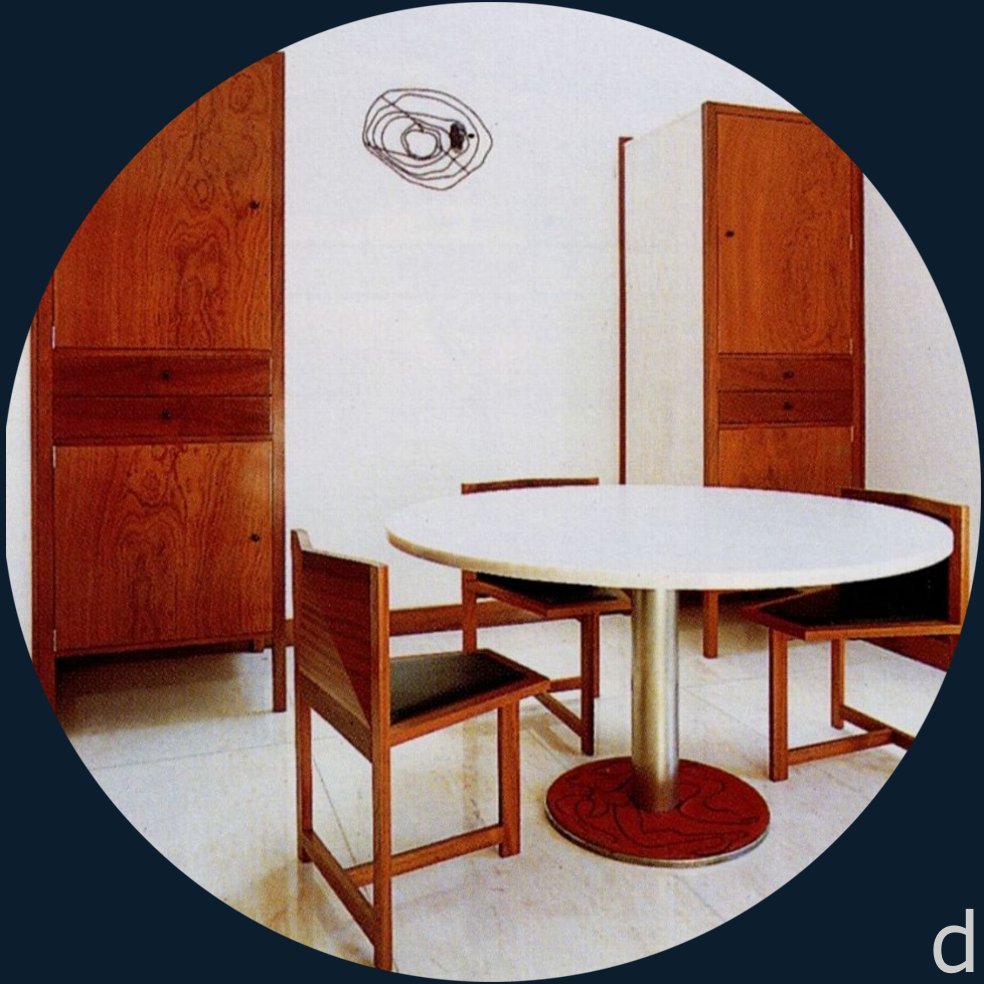
Up to now, Álvaro Siza has designed for the house an extensive list of furniture and fittings: steel arm lamps both in the wall and floor versions, a table lamp with a shade formed by a thin sheet of bent wood, a dining table with glass top edged in wood, several cherry-wood chests-of-drawers with handles that automatically retract by an inner counterweight, welsh dressers with the sides in pale marble that contrasts with the mahogany veneer, a round table in marble with a central steel leg, three-legged chairs whose seats are tapered to allow better use of the round table, glass-fronted bookcase-cabinets with a writing desk, a wall-lamp obtained simply from a plain sheet of bent wood, a floor lamp screened with a translucent marble disc, a chest-of-drawers which acts as the headboard and frame of the bed, a dressing-table, a bedside-chest with simply screened lamp, a single-drawer bedside table, a full collection of accessories for the bathroom, and even the design of two types of door and cupboard keys.
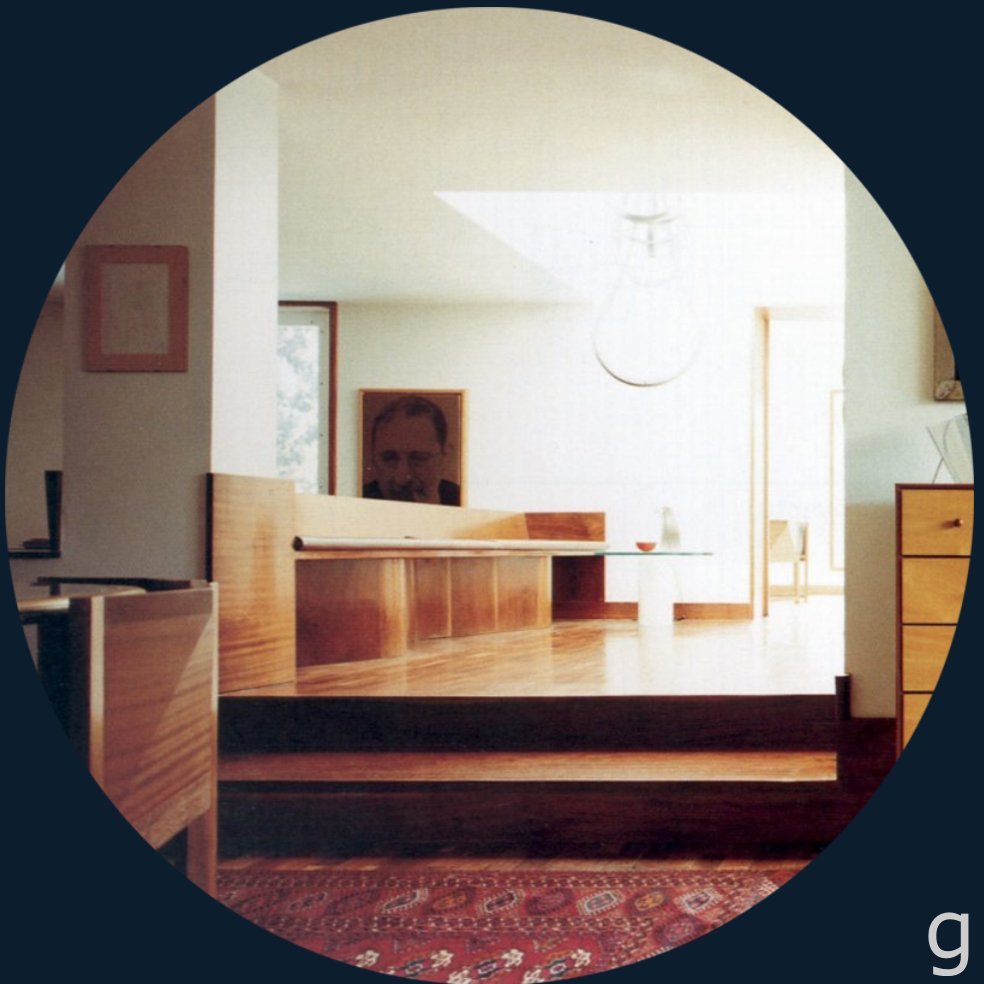
Now-a-days, almost all of the furniture is being mass-produced, the reproductions have become highly popular and are even exhibited in design museums. The simple solutions for furnishing the Miranda Santos House have now become original prototypes. This is a new stage in the life of the house, the house to become understood as a museum of the architect's furniture displayed within his own architecture. Indeed, as it were a retrospective exhibition at the house, a portrait of the architect greets our visit.

Photos: Luis Ferreira Alves, Alvaro Siza and Alessandra Chemollo.
1. Plan of the reformed house for Miranda Dos Santos in 1987.
2. The different openings in the white walls show the evolution of Siza's architecture.
3. Although the commissions of furniture for the Miranda Santos House finished in 1996, its owner has continued acquiring more designs from the architect; such as the mirror Álvaro, the ashtray Havana, and a garden chaise-longue.
4. Keys for doors and cupboards.
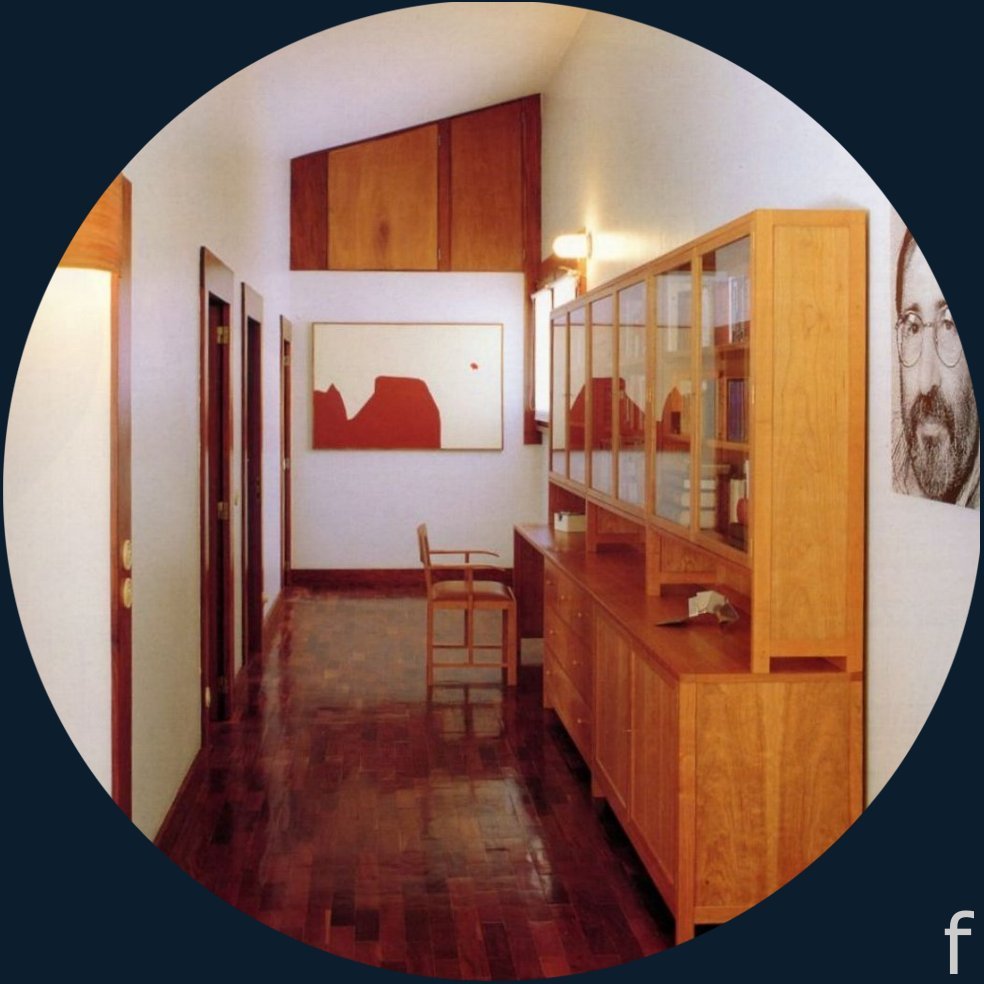
5. View from the corridor on the 1st floor with the furniture and a photograph of the architect. In the last photograph we know of the house, a poster sized portrait of Álvaro Siza Vieira (b. 1933) presides the living-room.

'MAISON À BORDEAUX' BY REM KOOLHAAS


A wealthy married couple with three children lived in a very old and beautiful house in Bordeaux in France. For many years this family was thinking about building a new home, planning how it could be and wondering who the architect would be. Suddenly, the husband had a car accident and almost lost his life. Now he needs a wheelchair. The old beautiful house and the medieval city of Bordeaux had now become a prison for him. The family started to think about their new house again but this time in a very different way.

Circulation in the new house.
The married couple bought a hill with a panoramic view over the city and approached the Dutch architect Rem Koolhaas in 1994. The husband explained to him: "Contrary to what you might expect, I do not want a simple house. I want a complicated house because it will determine my world."
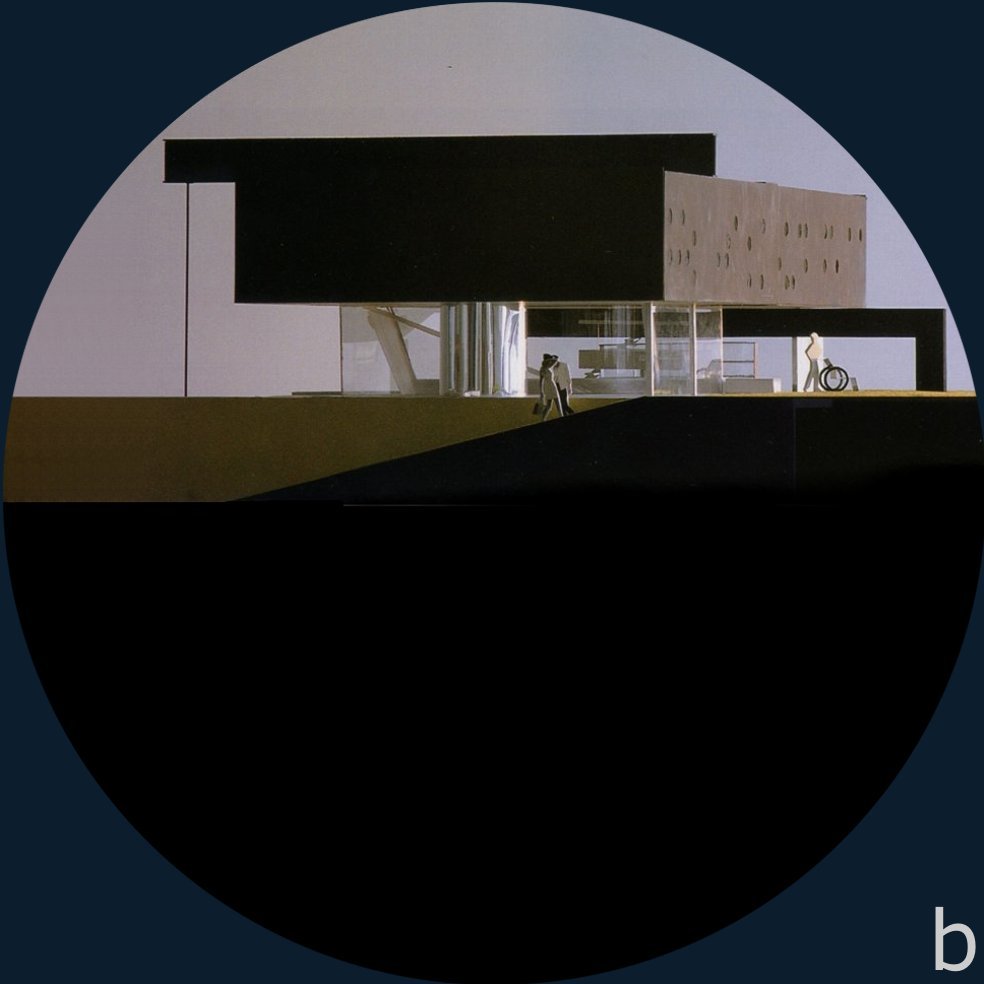
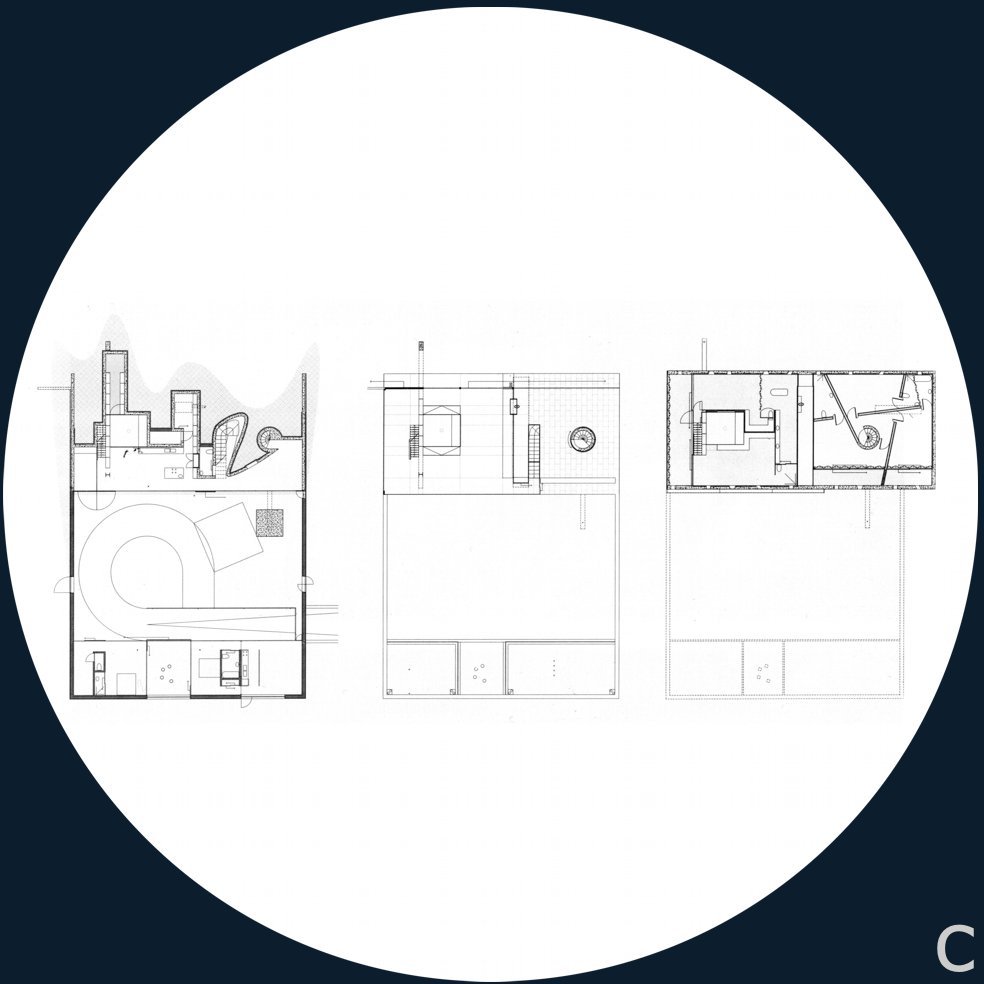
Instead of designing a house on one floor which would ease the movements of the wheelchair, the architect surprised them with an idea of a house on three levels, one on top of each other. The ground floor, half-carved into the hill, accommodates the kitchen and television room, and leads to a courtyard. The bedrooms of the family are on the top floor, built as a dark concrete box. In the middle of these two levels is the living room made of glass where one contemplates the valley of the river Garonne and Bordeaux's clear outline.
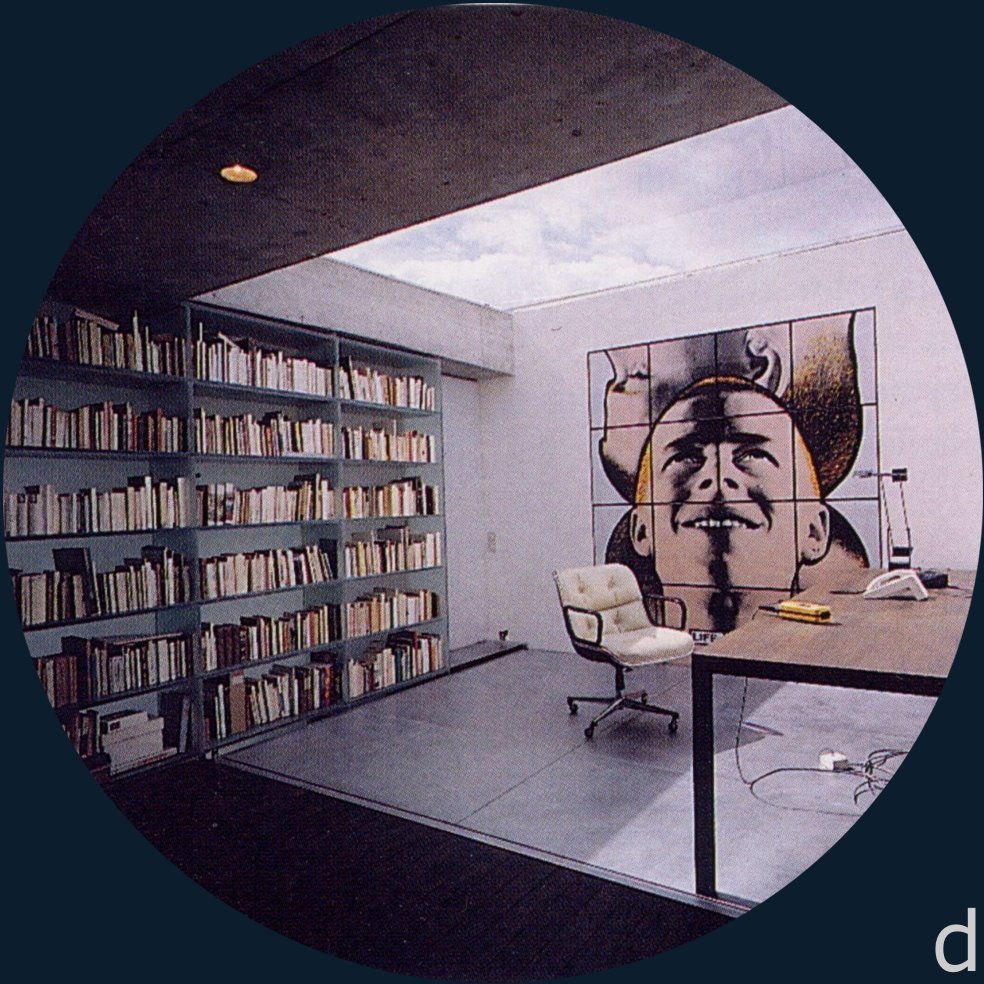
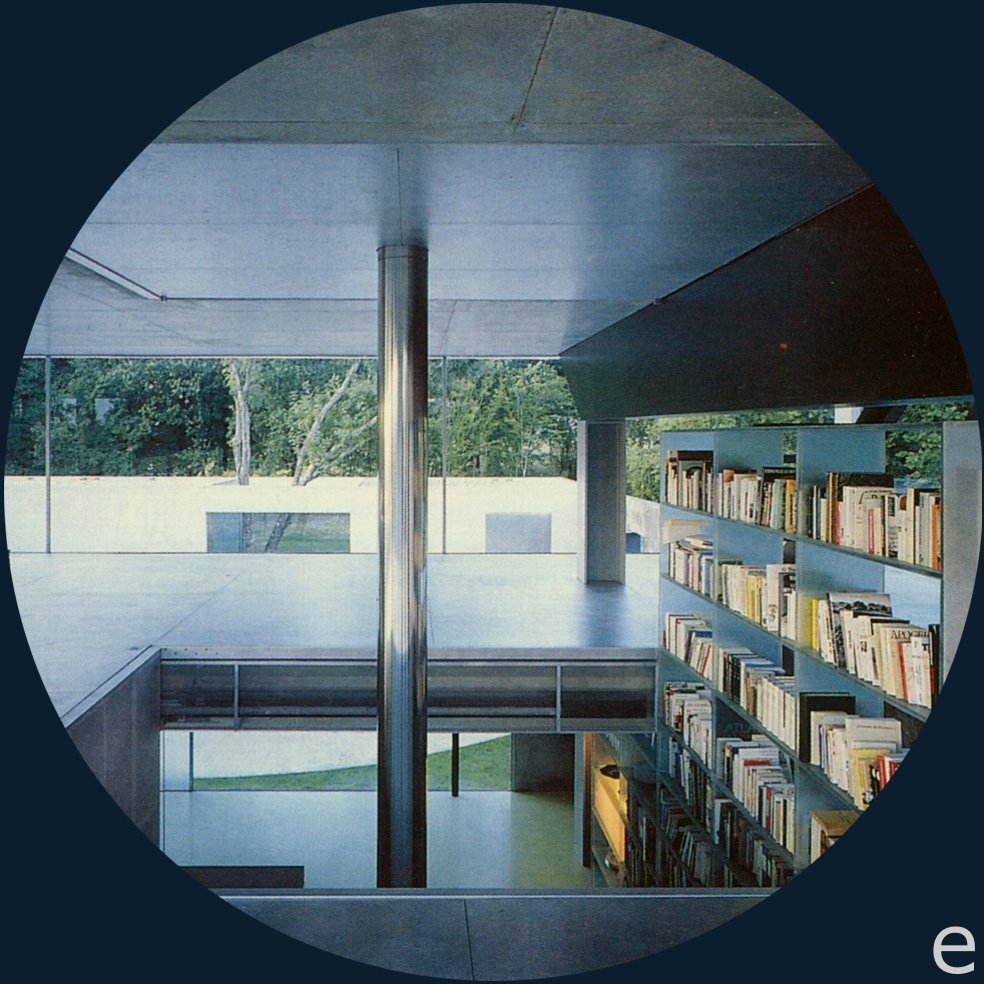
The wheelchair has access to these levels by an elevator platform that is the size of a room, and is actually a well-equipped office. Because of its vertical movements, the platform becomes part of the kitchen when it is on the ground floor; links with the aluminium floor on the middle level and creates a relaxed working space in the master bedroom on the top floor. In the same way that the wheelchair can be interpreted as an extension of the body, the elevator platform, created by the architect, is an indispensable part of the handicapped client. This offers him more possibilities of mobility than to any other member of the family- only he has access to spaces like the wine cellar or the bookshelves made of polycarbonate which span from the ground floor to the top of the house, and thus respond to the movement of the platform.

Experiencing the house.
Koolhaas designed a complex house in itself and surpassed the conventional, in every detail. For example, the top floor rests on three legs. One of these legs, a cylinder that includes the circular staircase of the house, is located off-centre. Although this displacement brings an instability to the house, it gains equilibrium by placing a steel beam over the house which pulls a cable in tension. The first question that the visitor asks is: what happens if the cord is cut? Koolhaas has created a structure which, equal to the life of the client, depends on a cable.
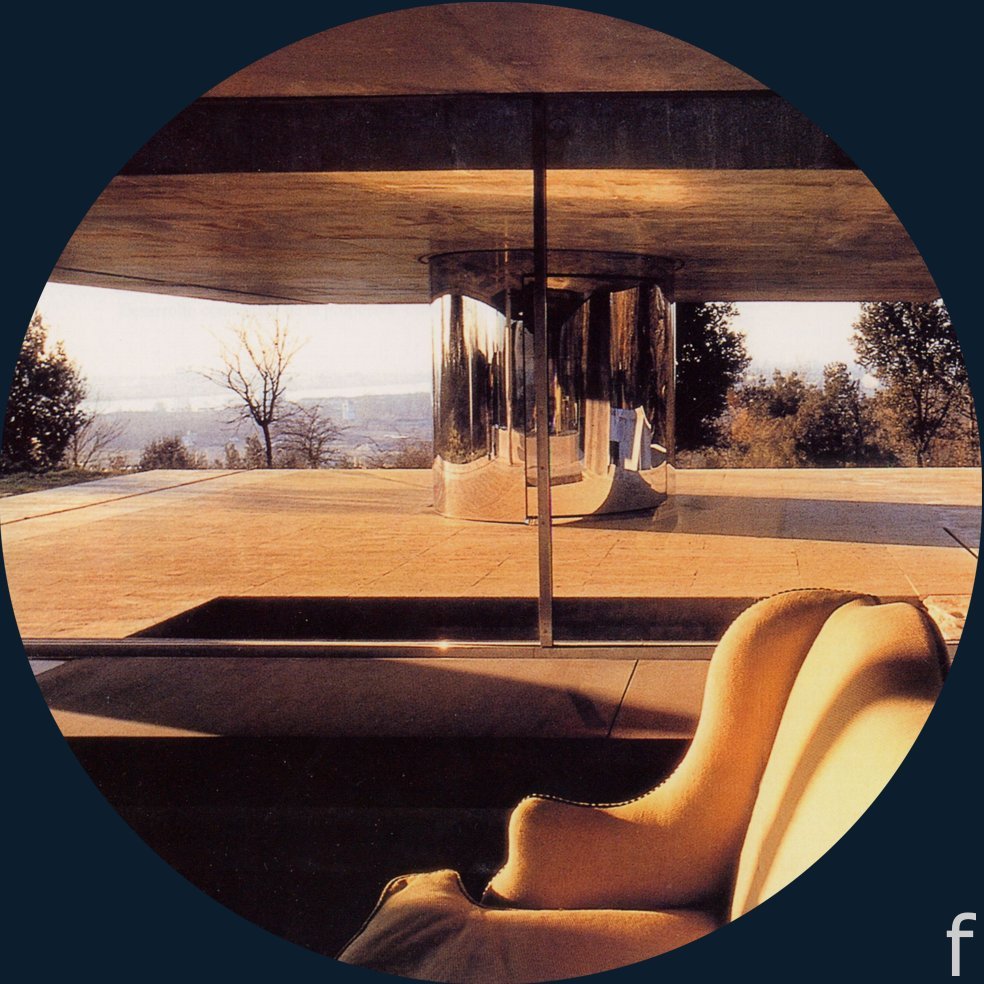
This arrangement provides the middle level with an uninterrupted view over the surrounding landscape, and an effect that is intensified with the highly polished finish of the stainless steel cylinder which incorporates the stairs, and makes it disappear into the landscape. The middle level is a balcony where the top floor floats above. It is a glazed space which allows the wheelchair to confuse the nature outside with the interior of the house. In contrast, the same landscape receives another treatment from the top floor. The view appears restricted and predetermined, framed by circular windows placed according to whether one stands, sits or lays down.
Inside the house the family experiences Koolhaas's interpretations of life's instability and dualities. In regards to the husband, he has experienced this instability and is now part of his own self. In the same way that the umbilical cord belongs both to the mother and the baby, and gives it nutrition; the elevator platform connects the husband to the house and offers him a liberation.

Appendix. It was with the greatest sorrow that we learnt, at the beginning of the year 2001, of the husband's death.

Photos: Hans Werlemann
Captions for illustrations
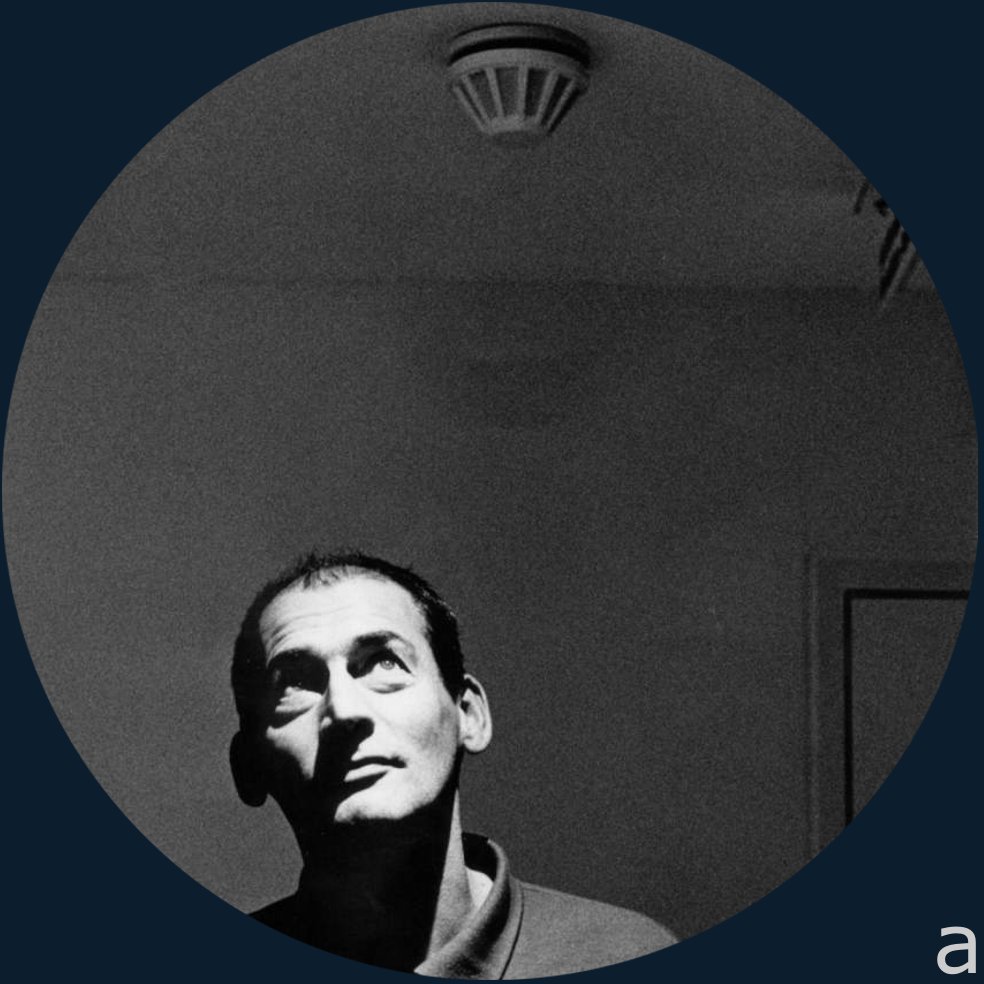
1. Rem Koolhaas (b. 1944). (Photo: Sanne Peper)
2. Working model for the 'Maison à Bordeaux'.
3. The architect surprised the family with an idea of a house on three levels, one on top of each other.
4. The husband has access to all three levels with an elevator platform which is the size of a room, 3 x 3,5m.
5. Bookshelves spanning three levels respond to the needs of the mobile office.
6. The middle level is a glass space which allows the wheelchair to confuse the nature outside with the interior of the dwelling.

VILLA ANBAR IN DAMMAM, BY PETER BARBER


A romantic novelist from Saudi Arabia approached the British architect, Peter Barber, in 1992 to design her house in the important commercial and port city, Dammam, in the Arabian Gulf. Mrs Anbar - a widow - divided her year between London and her native country, therefore her attitude towards Middle Eastern culture was characterised by cosmopolitan influences. On the other hand, as a Western architect designing in Saudi Arabia, Barber had to research the complexities of Islamic culture.

The interior of Saudi domestic houses
The traditional typology of interiors in Saudi houses reflects a profound sense of hierarchy between men and women. It is a rigid issue of segregation between sexes which is echoed in the two entrances to the house, and is followed up in the interior by separating men's and women's quarters. The degree of separation is further dec
lared - between servants and members of the family, and between the family and the outside world - by a series of increasingly private spaces which gravitate towards a central courtyard.
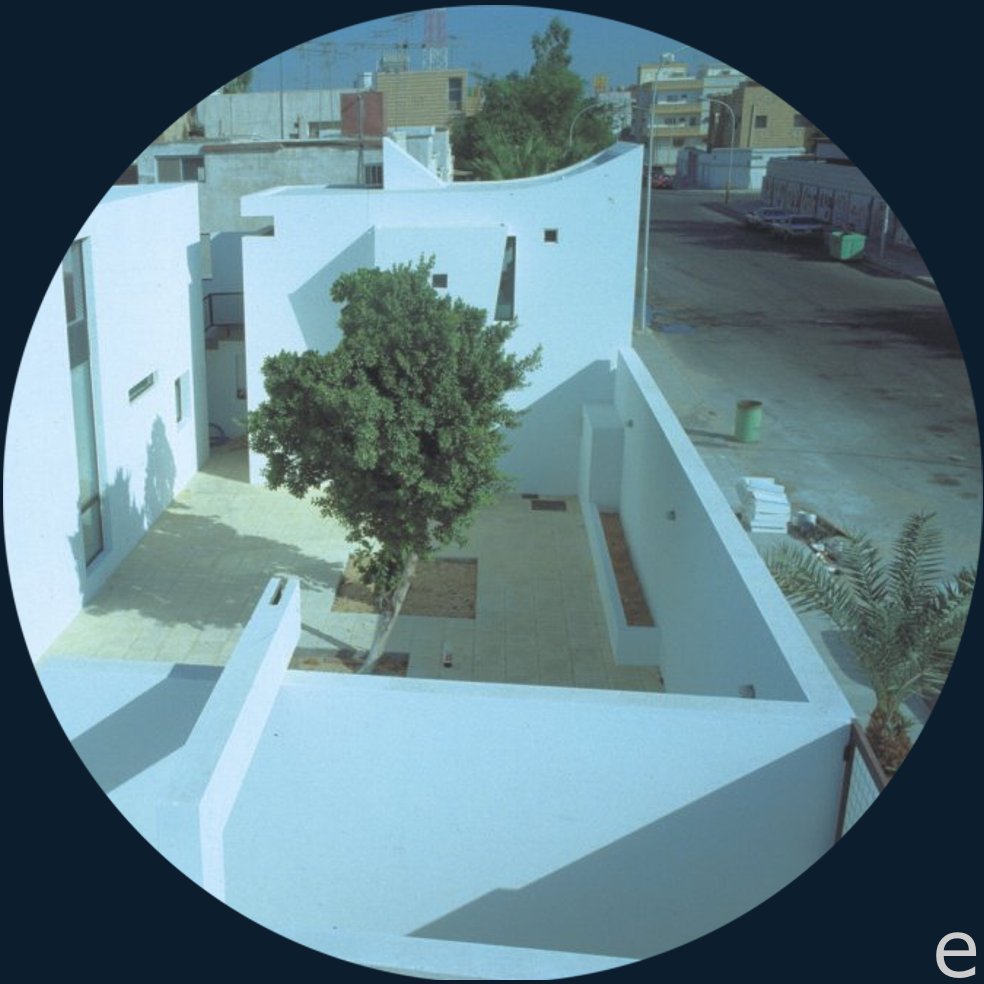
Undoubtedly, the context in which the villa Anbar was going to be built was not neutral. Political and religious leaders had far more power over architecture than even the architects themselves. Indeed, during the construction of the house, a nearby medieval settlement was razed to the ground by the government simply because its spatial complexity of tight alleyways and small squares created a problem of control for the authorities.
Faced with this unfamiliar environment, the English architect acknowledged that a close reading of the books Beyond the Veil by Fatima Mernissi and Sexuality and Space by Beatriz Colomina was influential in approaching the programme of the house. From that moment, the programme not only became to specify the rooms required by Mrs Anbar, her children and grandchildren, but also, and above all, to understand the house as a political space.

The profundity of the gaze
Peter Barber investigated the power of the gaze to determine the division of space in domestic architecture. From the most public area to the most private one, the eye was directed in very specific paths through different layers, either giving a full view or only a partial one, sometimes merely implying what could be seen.
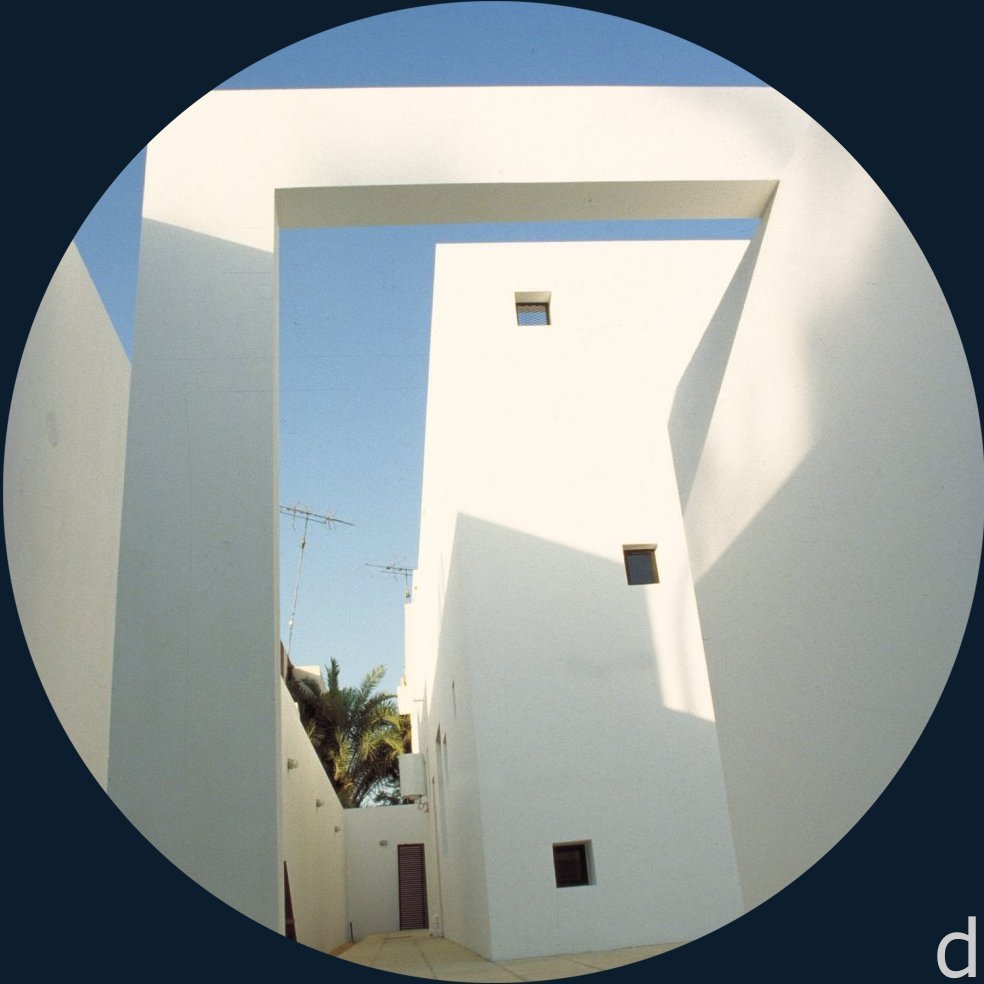
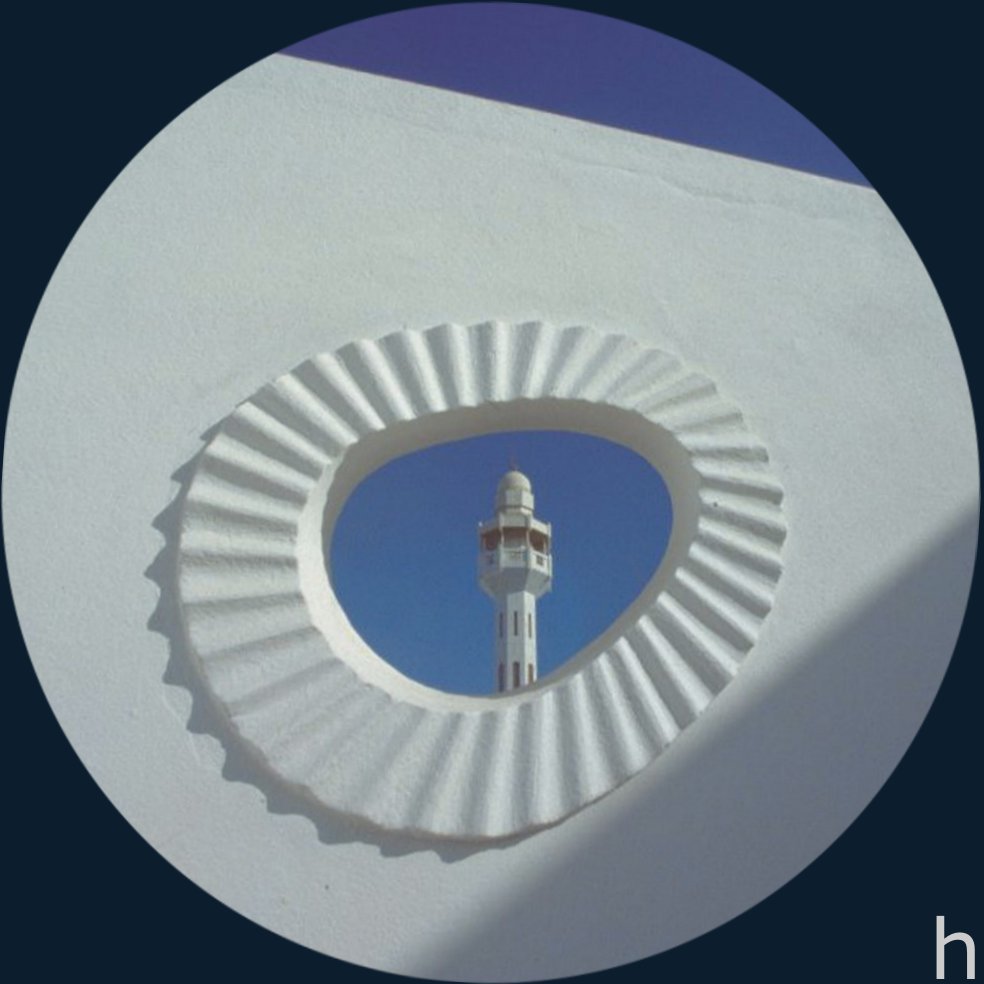
At the entrance, a gate gives a view into the courtyard, although a wall to the right prevents the gaze penetrating any further. The threshold is defined by a lintel that slips over the top of the wall. This lintel shows a dual aspect, a technical one of taking water to the swimming pool on the other side of the wall, and a metaphorical one of framing the gaze so as to give a hint of something else beyond. As one passes the entrance, tiny openings cut through the front wall of the house and signal the presence of the unseen occupants.
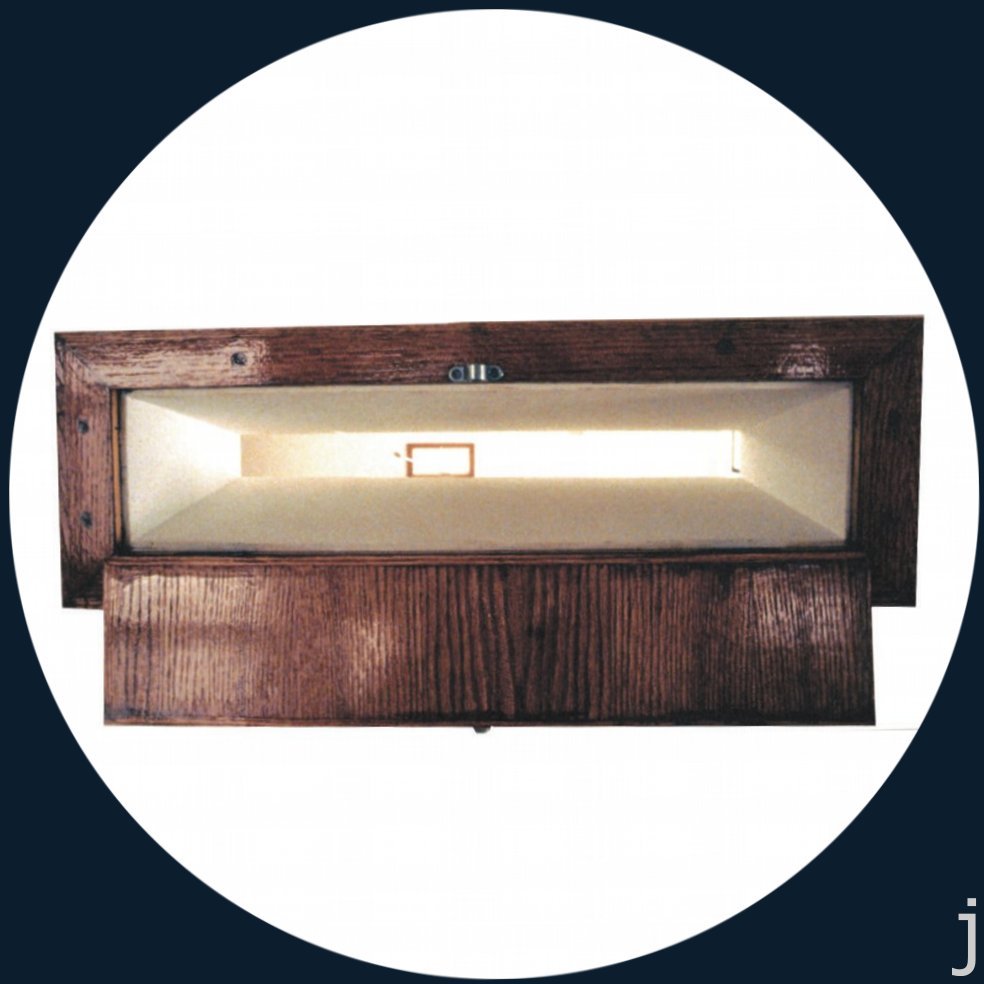
Although internally the house follows a traditional layout of separating men and women's quarters, this structure is broken by simple acts. Thus, as a crack, a horizontal cut in a wall of the women's quarter serves as a vantage-point for surveying the unseen, that is, the male domain. As might have been expected, male members of the family demanded that a shutter would be placed over the frame. This was done but, paradoxically, it was allocated on the women's side.
Opposite the pool, the driver's dwelling is placed on the first level projecting over the private garden. Looking down from his window, his gaze touches on the most private space of the family, in their time of leisure. Even if the window were to be blocked up, the presence of the servant would always be felt due to the volume of his room. However, the presence of the maid is more oblique. Her room, which is placed on the roof terrace and thus away from the family's private rooms, is connected to the central courtyard through a series of cuts. In that way, her gaze is allowed to penetrate into the symbolic heart of the house.
While Barber builds according to the usual gender and class boundaries demanded by Muslim society, he subverts these boundaries with gentle questions rather than formulating them in an obvious manner. This is an architecture that goes beyond formalistic considerations, that introduces a certain ambiguity which in turns initiates questions about social conditions and changes.

Photos: Peter Barber Associates
Captions for illustrations
a. Peter Barber (b. 1960) architect.
b. Ground floor of Villa Anbar: 0. Entrance, 1. Women's living room, 2 Men's living room, 3. Dining room, 4. Shower, 5. Toilets, 6. Kitchen, 7 Bedroom, 8. Courtyard, 9. Garage, 10. Maid's room, 11. Laundry, 12. Installations, 13. Driver's room.
c. The house has only one entrance from the street - partly due to the client's status as a widow. The visitors of both sexes cross in this space, where the sound of the water conveys the presence of the family in the swimming pool.
g. Window looking onto the men's living room from the women's living room.
i. Men's living room.

CAN LIS AND CAN FELIZ IN MALLORCA, BY JØRN UTZON


After having to abandon the construction of the Sidney Opera House in 1966, the Danish architect Jørn Utzon on his way home, made an intermediate stop at Mallorca. The island fascinated him to such a degree that he decided to build a summer house there. It was located facing the Mediterranean, on a cliff near a small fishing village and he gave it the name of his wife, Lis. In 1994, he felt obliged to move from his house, which had turned into a place of pilgrimage for architects. Utzon built another house, Can Feliz, also in Mallorca, but this time its location is kept a total secret.

Can Lis
Jørn Utzon had been affected, at the beginning of his career, when he learnt that the celebrated Swedish architect, Gunnar Asplund, had died of stress. On his death bed, Asplund asked his son whether all this effort had really been worth while. These words came back to Utzon years later when, after he had been nine years working on the design and building his winning project of the Sidney Opera House, he decided to resign from this job because he had not been shown professional respect by the Ministry of Public Works. Since then, Utzon has never returned to Australia to see his building finished.
Looking, in Porto Pietro, for an ideal refuge during his holidays, Utzon built Can Lis in 1972, set among myrtle and pine trees, with an extraordinary view to the sea. Integrating with the colours in the landscape, the main building material is a hard local limestone, called marés stone, which varies from gold to pink in colour. The original concept for the house was the same as for the one that Utzon had intended to build in Sidney; a sequence of pavilions linked by a wall, and arranged so as to respond to the various functions within the dwelling. He explained it with a story by Karen Blixen about African farmers where she said: "It was impossible for them to build their houses in a uniform row because they followed an order that was based on the position of the sun, the places of the trees and the natural mutual relationships of the buildings." The orientation of the pavilions in Can Lis selects distinctive views of the Mediterranean, and consequently, the furniture became fixed, built on site and finished with shiny ceramic tiles. Additionally, as the window frames were mounted on the outside surface of the walls, they were made invisible from the interior, which again, stimulates the effect of light, blurring the limits between the dark interior of the house and the blistering Mediterranean sun. For all these reasons, family life follows a route as the day passes which seems to pursue the passage of the sun.

Can Feliz
Utzon developed a new typology for housing in Can Lis, the house of the sun, from which we all have a lot to learn. In fact, the architect told us, with a smile, about the numerous visits of buses full of tourists arriving to this house.
Twenty-two years had passed from the construction of Can Lis when Jørn Utzon and his wife decided to spend the majority of the year in Mallorca. Due to the high humidity in winters, they handed Can Lis to their children and moved to a new house that they named Can Feliz. It is in the mountains, far away from the humid sea breezes, with big windows overlooking the green pine grove that reaches down to the sea.
Although both houses use the same materials, the second is a house in the mountains that belongs more to the traditional houses of the island, even reaching the point of being passed by unnoticed. Can Feliz is built round a terrace, following the pattern of orthogonal axis and is built under one tiled roof.
However much Utzon has insisted on his joy at receiving visitors, the fact that the house is so difficult to locate has contributed to the creation of the myth of the badly treated architect who has retreated into his refuge. Can Feliz has appeared in publication as it were a magical place and, includes, of course, the indispensable requirement of any utopia, apart from it marvellous qualities, be an insuperable gap from the rest of the world. In the same way as any novel on magic lands starts - with the loss of memory of the shipwrecked person who does not know how he arrived on the island, or the predicable cough made by the servant right in the moment when the narrator reveals the secret coordinates - the published articles on Can Feliz are reports by visitors who affirm that they are not able to remember the way that leads to the house.

Photos: Søren Kuhn
Captions for illustrations
a. Jørn Utzon (b. 1918) architect, at Can Feliz.
b. Looking for an ideal refuge, Utzon built the peaceful Can Lis, set among myrtle and pine trees, with an extraordinary view to the sea.
c. Can Lis. 1. court, 2. dining area, 3. kitchen, 4. work room, 5. entry, 6. covered terrace, 7. living room, 8. bedroom.
d. The semi-circular sofa in the living room of Can Lis follows the sun on the horizon while at sunset one ends up looking into the fire in fireplace.
e. Can Feliz. 1. entrance, 2. entry, 3. court, 4. work room, 5. living room, 6. kitchen, 7. dining room, 8. covered terrace, 9. bedroom, 10. terrace, 11. swimming pool.
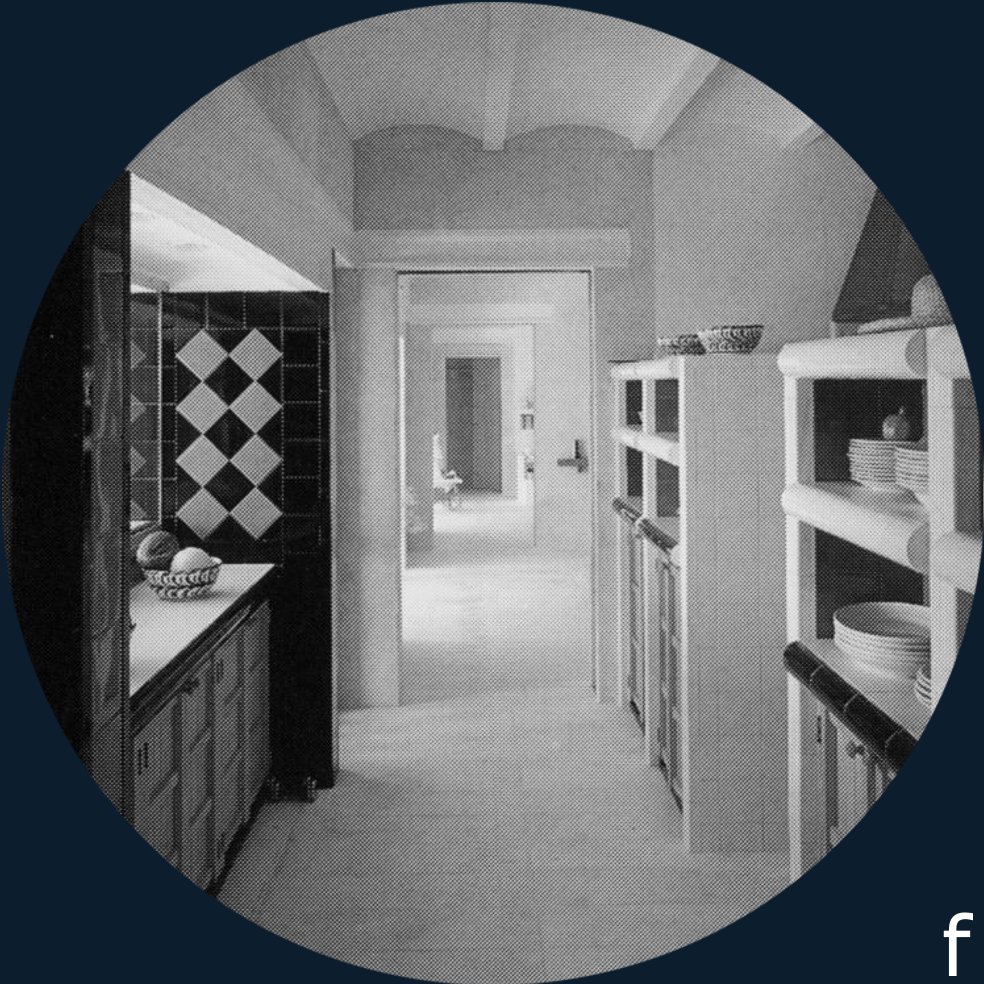
f. Shiny ceramic tiles in the kitchen at Can Feliz refer to traditional building methods on the island.

THE U-HOUSE IN JAPAN, BY TOYO ITO


The U-House was built in 1976 in the centre of Tokyo. It was designed by the architect Toyo Ito for his older sister, who had just lost her husband to cancer. In 1997 the house was demolished before Toyo Ito's eyes. How does one explain such an ending?

The Mourners' wishes
The client and her family had lived in one of the city's high-rise apartment. Following her husband's death, the widow requested that the architect build a house for her and her small daughters where they could enjoy the close contact with the soil and plants that their former home had lacked. She also suggested that the house be L-shaped to enable all members of the family to have visual contact with one another. By coincidence, the site next to the architect's house was for sale - the same site on which the widow had lived before she was married. It was as if she wanted to grasp hold of her memories in order to help reunite her family during such a difficult time.
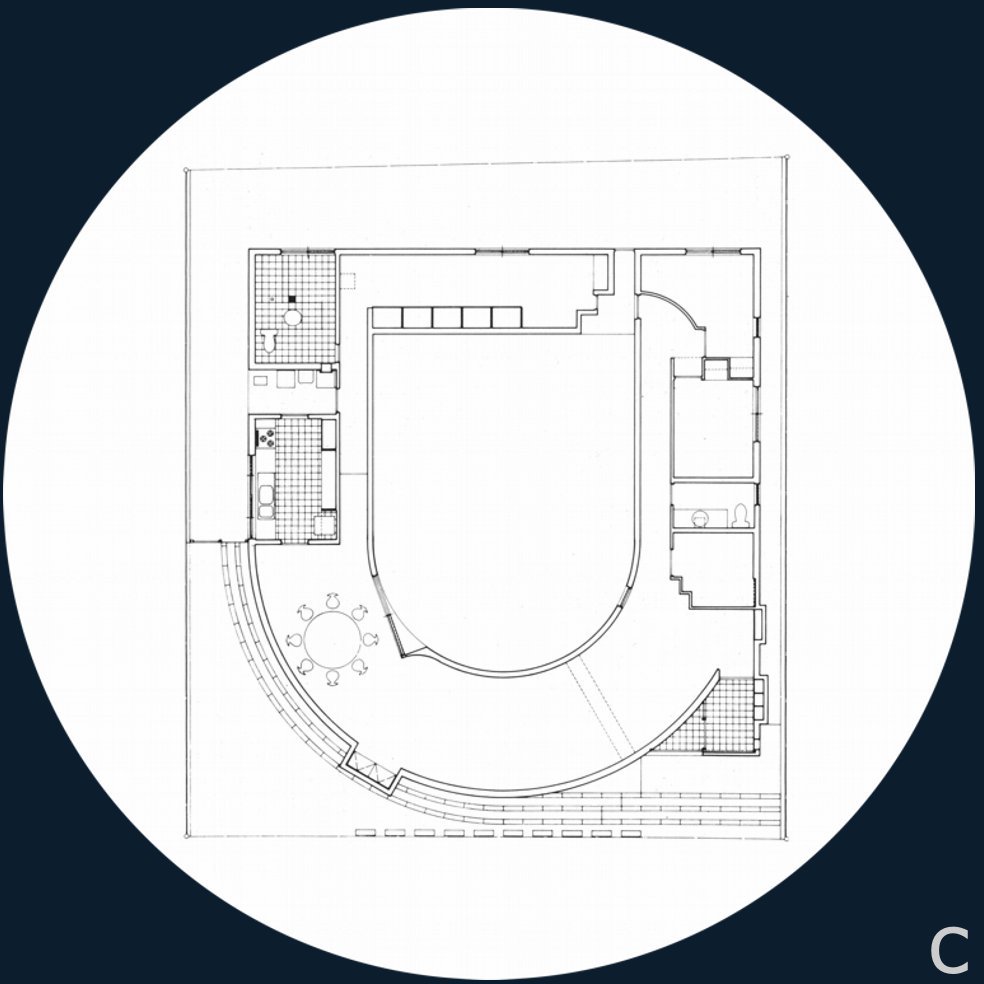
In the widow's conversations with the architect, the emphasis on organising functional spaces gradually disappeared and instead turned more towards the symbolic value of the space. Thus the house changed its initial L-shape to become a concrete construction with a U-shape, a form that would create greater light effects and a stronger relationship between the inhabitants.

The life of the house
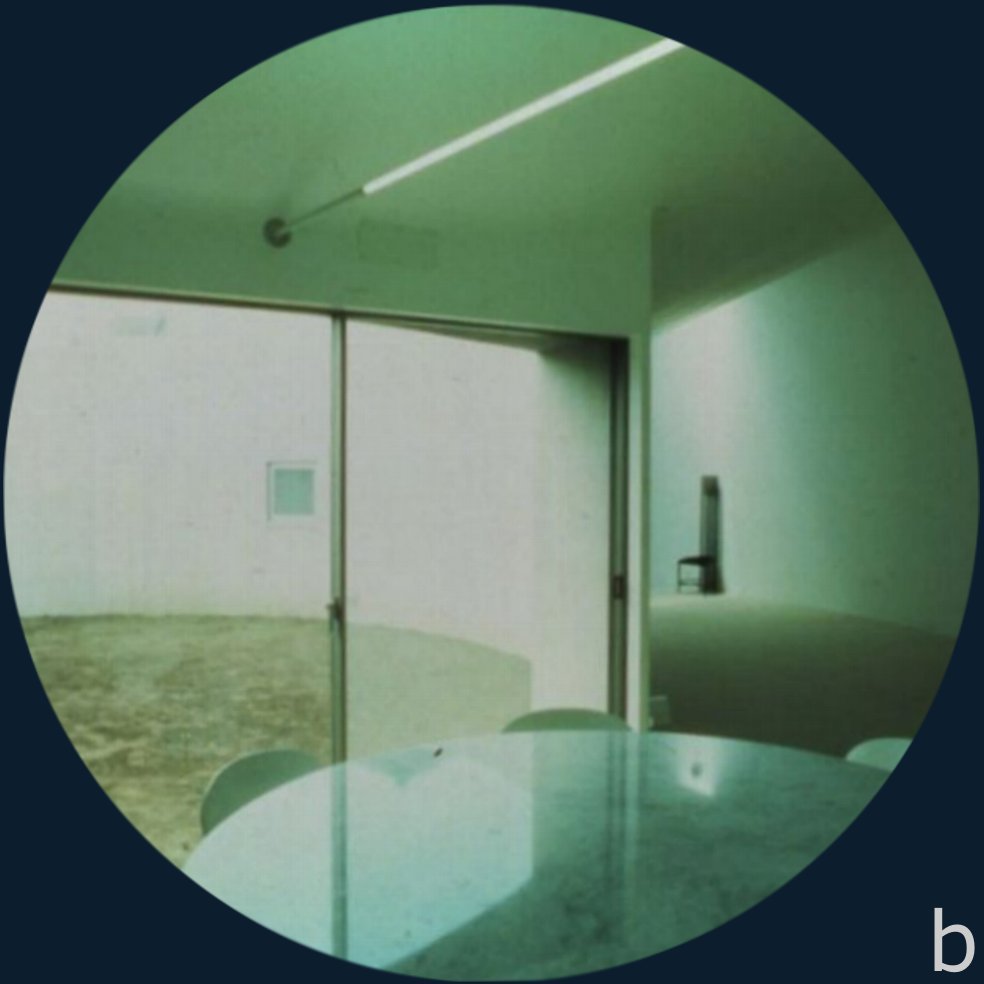
The U-House consisted of two long corridors, one of which ended at the girls' rooms, the other of which led through the kitchen and bathroom and onto the mother's bedroom. Both of the corridors were dark and led into the light - a source originating from the arc of the U. This multi-use space used for playing, dining and meditating, had its walls and ceiling painted white and floor covered with a carpet, also white. In this space the light was diffused and gave a soft texture, but a cut in the ceiling directed the daylight in a straight diagonal line. The powerful light effects were reinforced by the pure whiteness of the interior, which seemed flat and without any three-dimensionality. It was like a screen where the images and floating shadows of the inhabitants were projected; a space to project the human being beyond his or her body.
Twenty-one years after the completion of the house, the family was ready to re-establish its links with the outside world. The first one to move away was the older daughter. She had never thought of whether or not it was comfortable to live in the house, although she refers to the house as a coffin. This was perhaps best reflected by the behaviour of her many pets, all of whom had totally refused to be alone in the enclosed courtyard. The mother later moved to a smaller flat, but being a musicologist she had enjoyed the music echoing on the bare walls in the old house. The youngest daughter was the last to move out. She had developed certain sensitivity for aesthetics in this house that was reflected in her appreciation of Kandinsky and later, her eventual position as a museum director.
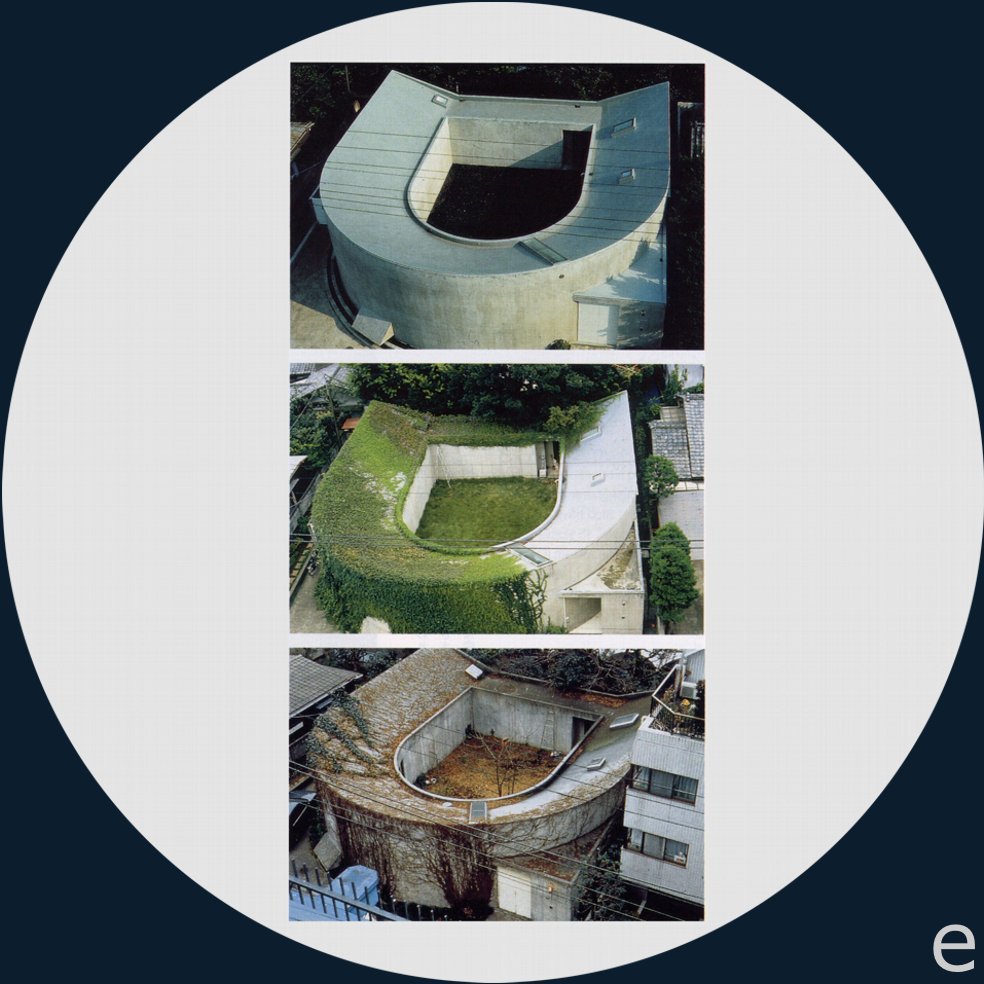
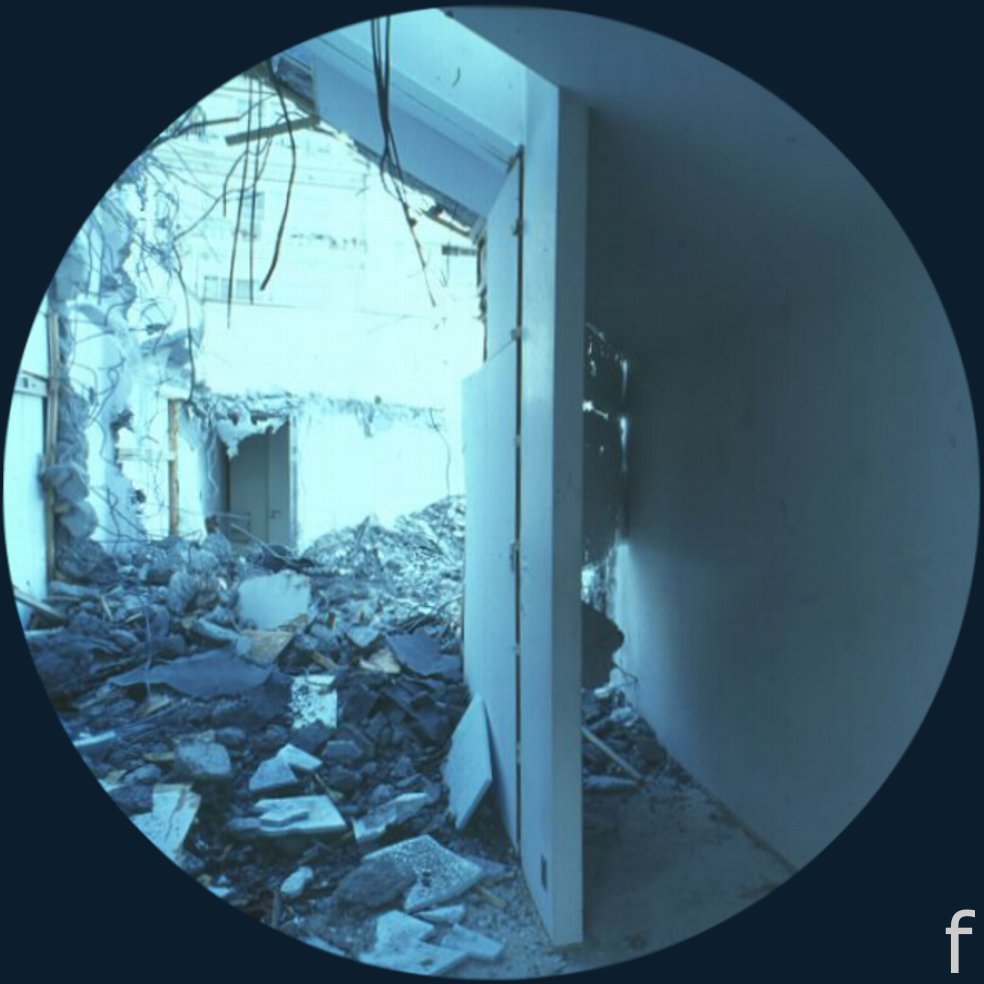
The last thing we know about the story of the house is from a powerful image in a photograph that illustrates its demolition. Instead of interpreting it as a destruction of a home, it is a sign of another stage through which the family progresses. The demolition is a symbol of renewal of life and consequently, we can argue that this was a house for mourners.

Photos: Tomio Ohashi
Captions for illustrations
A. Toyo Ito (b. 1941) architect.
B. One of the widow's desires was for visual contact between each member of the family.
C. Plan of the U-House.
D. A screen where the images and floating shadows of the inhabitants were projected.
E. The life of the house.
F. Demolition of the house in 1997.

HOUSE IN LÈGE, BY ANNE LACATON AND JEAN PHILIPPE VASSAL


Architects Anne Lacaton and Jean Philippe Vassal were asked by a brother and sister to build for them a holiday house on land they owned on the Atlantic coast of France. A key condition of their request was that the project should respect as much as possible the 46 trees – some up to 30 metres in height and over 80 years old – that grew on the site. The result was a dream come true; the dream that every child has, and keeps, of having a house in the trees.

The landscape
The site - located in Lège, west of Bordeaux - was one of the last in an area facing the Arcachon Bay Nature Reserve still not built upon. Sloping down harshly to the bay, the landscape consisted of 15 metre dunes covered with pine trees, shrubs and mimosa with views to the Island of Birds.
Despite their youth, the brother and sister (only 23 and 25 years old, respectively) had already learned to appreciate the beauty and the fragility of the land. Both were conscious of the harm that the neighbours had caused when building their own houses. All had cut trees and disturbed the landscape of dunes by moving earth, hollowing foundations and raising breezeblock walls.
It was through their father, an artist and a teacher of plastic arts at the Bordeaux school of architecture, how the siblings met Lacaton and Vassal. They spoke to the two architects about the beauty of that site - a site where the whole family used to picnic during the summer months; a site where they, as children, used to make huts between the trees. It was also during this first conversation that they voiced their concern as to how to build a house without destroying the charm of the plot, bearing in mind that some of the shrubs on the site were over 3 metres high thus prevented any view over the bay. Furthermore, local planning regulations required that their building had to be at least 4 metres from the neighbours and 15 metres from the shoreline - all of which meant that the house should be located just behind the crest of the dune.

Adding instead of replacing
Lacaton and Vassal began their response by acknowledging that although it usually seemed most comfortable to live on the ground, the analysis of the situation led them to a solution where they imagined a house in amongst the trees; a house that would be floating above the ground.
Faced with such an unconventional project, the clients nonetheless decided to have faith in the architects and to begin construction. As soon as they climbed onto the newly built platform, they realised that it was the right choice: from the 210 square metre concrete slab floor, one could enjoy a stunning view over the bay.
In order not to spoil the dunes, the foundations consisted of twelve micro-piles rammed eight to ten metres into the ground. On top of them, a galvanised steel structure was assembled on piles of variable height - depending on the slope of the ground - which allowed for a passage underneath the house. The insulation both underneath and on the sides of the house was protected from the seaside environment by a layer of corrugated aluminium sheeting. Since the corrugation laid perpendicular to the bay, the aluminium sheeting echoed the glitter of the water and illuminated the space beneath the house, creating an artificial sky.
Another consequence from the strict respect for the existing vegetation, was that six pine trees perforated the house. To enable the trees to move with the wind, while at the same time keeping the house completely rainproof, a rubber collar fastened the trunks to skylights. These skylights were Plexiglas plates tied to the roof of the house by elastic belts that allowed them to slide following the movements of the trees. The result was that the trees can almost be mistaken for the structure, appearing like symbolic pillars of the house.
By building a house around the trees and allowing the trees to live within the house, architecture and landscape come together.

Photos: Philippe Ruault
Captions for illustrations:
a. Architects Anne Lacaton (1955) and Jean-Philippe Vassal (1954).
b. Section and plan of the House in Lège (1998). From a wide balcony that acts as an extension of the living room, one enjoys a stunning view over the Arcachon Bay.
c. An automatic irrigation system monitors the soil humidity of the dunes underneath the house.
d+e+f. The windows in the aluminium facades are made of corrugated transparent plastic sheets, but the main facade overlooking the Bay is made entirely of large transparent glass sliding doors.
g+h+i. The architects conducted a study in collaboration with the French agricultural authority to ensure that the trees going through the house were not endangered by the project.

HOUSE IN BAIÃO, BY EDUARDO SOUTO DE MOURA


The Portuguese architect, Eduardo Souto de Moura, received a commission for a small house from a couple with two children, which would be built by the river, Duoro, set in the Baião hills. The client wished the house to have the character of a shelter used for weekends and requested that the existing ruins on the site would be the starting point for the project.

Between nature and the artifice
A ruin can be understood as the edge between architecture and nature. In other words, the moment when a construction ceases to be architecture and becomes nature. The work of Souto de Moura shows an interest in this dialectic between nature and artifice. A dialectic where the building site changes into a tool, it becomes a mental and an intellectual exercise in itself.
This sensitivity towards the site goes hand in hand with the belief in simplicity as a means to transmit thoughts. Following the words of the poet, Eugenio de Andrade, "... only the exact word is of public interest...", Souto de Moura believes that the tools used by the architects to write - with materials such as stone, iron and glass, as well as their joints, which are of no less importance - have as their final goal to create an anonymous and serene work in relation to time. In other words, to become poetry and to arose feelings.
Architecture of high complexity based on its contextual textures is, however, a consequence of this simplicity in the use of materials and its joints. It was inherent in the profound integration with the site, of camouflaging new spaces with nature, of fusing borders, underlining characteristics and expressing judgements of all the surrounding elements.
The ruin becomes important when understanding it as a division which defines the limits, as a fundamental element of spatial definition and of obtaining a concept of time. It maintains a dialogue with the context where it is placed. It is an architecture that is not forced, a silence where nature is seen as architecture and culture as nature.

The ruin Wall House 1990 - 1993
Responding to the wishes of the client, the ruin of the old farm which was attached to a retaining wall became interpreted as a kind of a bridge between internal culture (of the inhabitant) and an external reality (of time). The work began with the demolition of the retaining wall of big granite stone blocks, a traditional material of North Portugal. This was followed by the movement of earth, shaping a "negative" of the house in the ground and the old ruins began to take the form of a sort of a closed garden that served as a entrance hall for the house. This was a second building which consisted of a concrete box which was supported by the ruin and inserted into the earth. In this way, the ruin served as a joint between the past and the new rectangle house which, because of being partly set into the earth, was 'blind' on its side walls except the front facade which opened towards the river, Douro. From the interior, next to a fire-place built of stones from the old retaining wall, one could enjoy a view to the far away valley of Cerdeira through the glass facade.
The simple programme of the house is laid out in one level under a grass roof which forms part of the topography of the place. Being faithful to the concept of the ruin ceasing to be architecture and becoming nature, the house is camouflaged by the landscape in such a way that it is not the trees' foliage which acts as a second skin but the landscape itself.

Photos: Luis Ferreira Alves
Captions for illustrations
a. Eduardo Souto de Moura (1952), architect.
b. The family asked for a house of minimum dimensions to spend weekends by the river Duero.
c. The access to the house is through a garden inside the ruin.
d. The glass facade goes above the ceiling. This construction detail makes the only facade of the house to be perceived as a tensed plain of glass and aluminium, parallel to the old granite walls.
e. In the interior, a big wardrobe which covers the wall, orders the objects in each room and also contains the kitchen.
i. Present situation. It can be rented at: http://64.233.183.104/search?q=cache:9sKCPdnglVQJ:www.ownersdirect.co.uk/portugal/P743.htm+house+in+baiao+souto&hl=es&ct=clnk&cd=7&gl=es&client=firefox-a

BLAS HOUSE IN SEVILLA LA NUEVA (MADRID), BY ALBERTO CAMPO BAEZA


Having a steep and “uncomfortable” site yet with a beautiful view over the horizon, a professor of literature in Madrid approached the architect, Alberto Campo Baeza, to design a house for his family where they could “listen to music”. As a present he gave the architect a beautiful book of poetry, as it were provisions for starting the design process. Thus, the client directed the architect whose world-wide reputation was recognised for his poetic treatment of natural light.
With this mutual cultural understanding between the client and the architect, a house was being born where one listens to the music within the silence.


A house for emotions; to forget and remember
The first day that the client, Francisco de Blas, visited the architect he gave him a book of poetry from 1950 with the complete work of the Spanish poet Luis Cernuda (1902- 1963) who had been a member of the group of poets, Generation 27, with Federico García Lorca among others. Cernuda’s poetry was dense with intense emotions, describing sensitivity and love, pain and solitary, and the contrasts between the realisation of his personal desires (the wish) and the limits imposed by the world around him (reality). His most famous poem Donde habite el olvido (1932-33) describes a world where one forgets all one’s problems and in that way manages to achieve the freedom that one longs so much.
This was the reading material that the professor of literature transmitted to his architect. It seemed as if Francisco de Blas wanted something more than a house, that he wanted place where emotions and reflections were part of the building material. For Campo Baeza, this was a welcoming challenge. In fact, he intended his architecture to speak poetry and in order to transmit that to his architectural students he started every lecture for his classes at the University with an opening of the poem, Auguries of Innocence by William Blake:

To see a World in a grain of sand.
And a Heaven in a Wild Flower,
Hold Infinity in the Palm of your hand.
And Eternity in an Hour.

The house in the mountain for listening to silence
With these provisions, Campo Baeza went to visit the site with the client. It was to the southwest of Madrid with a wonderful view to the north towards the mountains and 3000 squares metres with a difference of 15 metres in height from bottom to the top. Despite that the client thought it very uncomfortable, the architect realised immediately that the place was perfect for the brief that the client had given him. Being so high, the surrounding houses would disappear and would leave the horizontal landscape in the distance to be enjoyed.
Studying the slope, Campo Baeza decided to make a platform for the house to sit on and to divide the house into two conceptual elements: a solid concrete box sitting firmly on the ground emphasising its sense of gravity and another transparent glass box placed on the concrete box with a light and simple steel structure that almost disappears into the landscape. The perfectly carved out box contrasts with the structural qualities of the second, the viewpoint situated at the highest point of the house. They are two opposing states or qualities of how light transmit through the material; one completely opaque and the other completely open.
Inside the concrete box is the programme of the house dividing the spaces so as the living areas - the four bedrooms and the living room - have a view of the framed landscape through square gaps that open out to the horizon. The effect is as if the landscape is far away from our reach in the distance. The opposite is felt in the totally transparent box on its roof where one is literally absorbed by the power of the surroundings. It is here that the inhabitant can loose all sense for the time, to listen to the sounds of the ambience, of the silence, of the music of the landscape. One recalls the effect of John Cage’s musical piece “4 minutes and 33 seconds” (1952) where the pianist sits in silence in front of the piano while the audience listen to the sounds of the surroundings. No two people listen to the silence in the same way. In fact, people are generally not educated in listening to the silence.
In de Blas house one finds peace within oneself and gains freedom. The experience is deeply personal, based on reflections; forgetting and remembering and relating oneself with the environment. Francisco de Blas and Alberto Campo Baeza have made a house where its poetry helps to build another more subjective poetry of the one who perceives the place.

Photos: Estudio Campo Baeza
Captions:
a. Alberto Campo Baeza (b. 1946)
b. Why should this house appear in so many books on Houses, whether it is a World Atlas or a pocket book on Houses?
c+d+e+f. Light is not only capable of revealing the spatial form, but also of dematerialising its structure.
g+h+i. A path from the sense of gravity to the sense of transparency.

THE HOUSE AKTION POLIPHILE BY STUDIO GRANDA


Escaping from the traffic noise of Wiesbaden, in Germany, the Koening family decided to fulfil their dream of living near the woods. In order to do so, they organized an international competition in 1989 between young architects. In the invitation, they made it clear that they did not look for "the world's most beautiful house, nor a house for an astronaut, a politician, a painter or a sculptor, but a house for an ordinary citizen."

A house for an ordinary citizen
Through the architecture and design gallery ZB in Frankfurt, the Koening family announced a competition by invitation. The selection for the participating teams was made based on advice from fifteen prestigious architects, who counted among others; Rafael Moneo, Robert Venturi, Tadao Ando, Alvin Boyarsky, Daniel Libeskind and Peter Cook. The competition was received with enthusiasm and forty-two architects participated in total, originating from fifteen different countries.
Each participant received three documents for the competition. The first one consisted of information about urban planning and climate as well as including photographs of Wiesbaden. The second one consisted of a list of required rooms. They were essentially the same as the couple and their two children had in the old flat in Wiesbaden and which already included space for accommodating two or three guests.
The family completed the program for the house with a third element of inspiration: the novel Hypnerotomachaia Poliphili" written by the Italian monk Francesco Colonna in the 15th century. It deals with love and passion, aspects of life that Colonna was not allowed to think about as a monk. The main character was the hero Poliphili, who wandered through the Harz forests where he met Delia, the chaste Roman goddess of youth, energy and health. Through his dreams, the novel became an allegorical tale about the struggle of love and the dark side of the human soul. Without looking at our shadows, one cannot understand human reality.

The Houses of Delia and Saturn
Margrét Harðardóttir and Steve Christer, the architects proposed by Professor Peter Cook and who are the founders of Studio Granda in Reykjavík, won the competition with a house where vices and virtues of every ordinary citizen were reflected. Their project interpreted Delia as the image of contemporary life - light and modern. They also decided to work on the presentation of the past - massive and primal. Although Saturn did not appear in the novel as a character, they introduced this god who, according to Roman mythology, represents the dark side of the human mind. He symbolises the idea that time creates and then obliterates its creation. Together, Delia and Saturn came, in that way, to constitute the symbols of life's ambiguity in the project.
Based on these propositions, the project was divided into two houses: the delicate 'House of Delia' which became the family dwelling and, one much smaller in scale but heavier, the 'House of Saturn', the guest accommodation, which was built in stone.
When entering from the street, the red sandstone of the 'House of Saturn' put s a shadow on the visitor. After walking underneath the corner of Saturn, the wall is replaced by unexpected twisted and knotted topiary trees. The strong fragrance from flowering plants intensifies the crossing of a bridge to the main entrance door of the 'House of Delia' through which a glimpse of the distant forest is seen. Delia is a very light and lively building, with its exterior constructed with a play of cedar sticks varying in thickness, twisting and turning gently. Their density on the north side reminds us of Poliphili roaming in the German forests. It is like a testimony of the confusing world and the agony through which his mind went.
Inevitably, the two houses are entwined by their circulation systems. In Delia a spiralling route winds from the basement to the roof terrace. As it passes the entrance hall it is cut by the path from the street gate, which has passed under the shadow of Saturn. It is as if everyone must pass under his shadow because without Saturn, Delia would not exist. He is her ancestor and she rests on his outstretched arm, fragile and light.
The novel "was a magical device for manipulating a straightforward brief on an extremely difficult site", explains Studio Granda. Although the main concern of the family Koening was to meet all the practical considerations, the architects also engaged them in a lyrical play through the characters of Delia and Saturn. In this way, from the consideration of the dual nature of the human being, they built a house that could well be for any of us.

Photo credits: Norbert Miguletz
Captions
a. Margrét Harðardóttir (b. 1959) and Steve Christer (b. 1960), architects, founders of Studio Granda.
b. An engraving in the book shows the hero, Poliphile, wandering through the forest of emotions.
c. House of Delia: a- living room, b- dining room, c- kitchen, d- entrance hall, e- cloak room, f- guest toilet, g- stairs to garden, h- void, i- stove, j- laundry chute, k- facility wall, l- terrace, m- statue of Janus. House of Saturn: n- study, o- library, p- toilet.
d. The House Aktion Poliphile consists of the 'House of Delia' and the 'House of Saturn'.
e. In Delia a spiralling route winds from the basement to the roof terrace, a private space where the family can enjoy the view of the landscape and sky.

VILLA SAINT-CAST IN BRITTANY, BY DOMINIQUE PERRAULT


What can a lover of sailing do when her family inherits, not a pontoon, but a landlocked site in the countryside on which to build their home? With this question, Aude Perrault - wife of the architect of the French National Library in Paris, Dominique Perrault - explained the dilemma she faced when thinking about building a new dwelling inland. She longed for the freedom that she felt while sailing, and wondered whether the land could provide the same feeling of grand spaciousness as the sea offered her.

The house as a boat
Aude Perrault, besides being an architect and sharing an office with her husband, had a true love of boats and the sea, and has for years taken part sailing competitions. She inherited 4000 square metres land in Côtes d'Armor, north of Brittany, with a limited view to the sea only in the winter days when the ancient oak trees on the site lose their leaves. Despite such a landscape, she asked herself whether her house, "could only be a boat?"
For Aude, the soft lawn was as the curve of green tide to which one continually adjusted one's self. These waves in the land - the small hills that moulded the landscape - might even hide any view of the house. She took this analogy further, comparing the existence of a dwelling on this site to a boat in the sea, "that appears and disappears once and again according to the caprice of the swell."
With the house disappearing into the ground, its architecture would also disappear. It was like recuperating the primitive notion of the house, in a way, as a shelter in the landscape. Precisely that feeling had to be felt from inside the dwelling, the same one as of living in nature listening to the whispering sounds of the leaves of the oak trees or, in summer, of the sea when its sounds were brought nearer by the north-easterly winds. Merging the house with the environment, in other words, would offer Aude that sense of freedom that had originally inspired her : the idea of a house as a boat surrounded by soft waves of the landscape.

Living underground
Dominique Perrault's projects have increasingly concerned themselves with valuing landscape as the linking element between architecture and nature. Following that line of thought, the design for his own family's house brought him to experiment and to question whether contemporary man could live underground, whether it would be possible to propose a return to the primitive cave as the original human habitation and in doing so, to understand the emotion of living in close relationship with one's surroundings.
When did history of architecture begin? The first prehistoric shelters were not manmade -they were caves found in nature and ready to be inhabited, although they had first to be wrested from other predators. Since then, more than a million years have passed. They were times when people were still unaware of architecture, if one understands architecture as ambition to create an environment different from the natural order. Nevertheless, if one considers architecture expressing the act of making places for ritual use, it describes one of the basic human needs. The inhabitants of the caves lit fires in the entrances to keep them both warm and avert animals, they cooked meals in the interior of these caves, the prey that they had hunted, while the most inner recesses came to be reserved for the ceremonies of life, death and afterlife. They pushed further and further back into the cave - using the area in an increasingly sophisticated manner according to its function. In other words, prehistoric man transformed caves into architecture through use.
Dominique Perrault began his dwelling by excavating the land in order to embed the house in a hill. The fissure was a perfect rectangle of long proportion - 400 square metres of emptiness in which to accommodate the various rooms of the dwelling. The only facade is an enormous glass wall almost 50 metres long running along the entire length of the building and opening completely into the garden. Behind it is an immense living room, which can be modified through a series of mobile screens that create the desired space for each moment or activity. The only permanent construction is a container - consisting of six bedrooms, a kitchen, dressing rooms and bathrooms - which is placed in the most interior part of the space. Daylight enters to this inner area of the house from skylights made as if they were cuts in the grass on the roof.
At that point, the house and its surroundings are undividable, or as Aude liked to say , it was as inseparable as the touching surface between the hull of a boat and the sea. When at last, she and Dominique were contemplating the model of the project that presumably would answer all their questions, he asked himself: This house, is it really a house?

Captions for illustrations:
1. Dominique Perrault (b. 1953), architect. (Photograph: Marie Clérin)
2. Villa Saint-Cast (1993-1994). This house, is it really a house? (Photograph: Georges Fessy)
3. With the house disappearing into the ground, its architecture also disappeared. (Photograph: Georges Fessy)
4. The house inhabits a 400 square metre rectangle. The only construction in its interior is a container with six bedrooms, a kitchen, dressing rooms and bathrooms, to which one has access from the immense living room.
5. The enormous glass wall of almost 50 metres is the only facade and can be opened completely out to the garden. (Photograph: Georges Fessy)
6. A view from the kitchen towards the garden. (Photograph: Georges Fessy)

A FAMILY HOUSE AT RIVA SAN VITALE, BY MARIO BOTTA


Carlo and Leontina Bianchi were close friends of the Swiss architecture student, Mario Botta, when he refurbished an old flat for them in the village of Genestrerio, Switzerland. In 1971, after recently finishing his studies, Botta was asked by the same family to design a new house, but this time in the countryside of the Ticino Canton, at the foot of Monte San Giorgio, overlooking Lake Lugano. Although the brief was very similar - a low budget house with rooms for a couple with two children - the process of thinking this new house was very different. In fact, it was now like building a house starting from the roof.

Vernacular architecture
At the north of the old fishing village, Riva San Vitale, the site is at the end of a small road that ascends along the mountain slopes towards the border of an extensive wood. It was a beautiful land of 850 square metres covered with tall chestnut trees, which Leontina Bianchi inherited, set on a steep hill that lead down to Lake Lugano and faced the impressive Monte Generoso between the peaks of the Lombard Prealpi which are usually covered with snow.
Characteristics of this region were the clear volumes of old buildings that raised over the trees as traces of human marks. Apart from the 16th century temple in Riva San Vitale, there were once plentiful old "Roccoli", or traditional bird hunting towers. Later, although many of them were destroyed, some were converted into weekend houses. It was precisely this combination of astonishing nature and basic construction which gave a special quality to the area.
Nevertheless, during the last century, the land along the small road which ended in the Bianchi's site, had suffered by indiscriminate planning development. Consequently and from the very beginning, Mario Botta's main concern was to propose a house that would mark the limit of the careless expansion of the village as a means of protecting the woods. Due in part to Botta's protest with his powerful architecture and shortly after the completion of the house, a new urban planning regulation declared the environment as a green belt and, hence, no further building construction was approved in the area. This is the reason why this house stands alone in its protected landscape.
Acknowledging that with building one transforms nature, Mario Botta insisted on committing himself to build a pleasant and human space. Evidence of this dialogue are in the posters from the Ticino Tourist Office which shows images of Swiss landscapes with Botta's architecture. In the case of the house at Riva San Vitale, he reinterpreted the vernacular type of tower to protect the landscape, together with answering his friends' wishes of both enjoying the views of the lake above the trees and by having a strong contact with the ground.

Building the landscape
From the old road that reaches the site at its top, a thin metal bridge leads to the house which is formed as a 13 metres high by 10 metre square tower. The 18 metres long gangway emphasises a separation from the land and reveals the house as an observatory of the surrounding landscape. The feeling, when crossing the bridge towards the house, is of entering into the landscape, and one's eyes extend beyond to the church of Melano, at the other side of the lake.
Since the house is organized around a central staircase, its spiral circulation faces different views. From the entrance, and in descending order, there is a studio and an upper terrace on the east overlooking the lake and the mountains; the parents' bedroom with its spacious terrace facing south to the meadows, and then, below the floor with the children's bedroom and playroom. Moreover, all the bedrooms are open to a triple height space, so they communicate visually to each other and to the spaces below, including the kitchen and living room. Finally, there is a cellar and a big porch that opens directly to the ground.
The house is like a carved volume with four elevations which responds to the surrounding environment: the lake, church of Melano, the meadows, the woods, and the old access road with the green. Each aperture in the facade frames a specific view and expresses Mario Botta's belief that architecture is the design of a location. Therefore, his facades are not simply a question of decorating the exterior surface of a building. They express a relationship of the interior of the house with the surroundings, the movement of the sun, or the direction to an existing historical construction; they have a geometry that corresponds to the abstraction of the surrounding landscape.

Captions for illustrations:
a. Mario Botta (b. 1943). (Photo: René Burri)
b. Old "Roccolo" characterise the Ticino region.
c. The walls consist of a double-layer concrete blocks unplastered and painted white only on the interior, the floors are terracotta, and the bridge is an iron frame painted red. All of them are simple and common materials that reappear in the construction with the quality of treatment elaborated from Botta's old Professor at Venice University, Carlo Scarpa. (Photo: Antonio Martinelli)
d. The house is a carved volume that responds to the surrounding environment. From its more than 1000 cubic metres only 220 square metres are inhabited.
e+f. The interior of the house is the exterior landscape. (Photo: Alo Zanetta)

CLOSED FOR THE HOLIDAYS


Happy reading!

ROGERS’ HOUSE IN WIMBLEDON, BY RICHARD ROGERS


When the Second World War was imminent, the political situation became unbearable in Italy for many. Due to his Jewish origin Dr. Nino Rogers found himself in that situation and was obliged to emigrate to London from Florence in 1938 with his wife Dada and their five year old son, Richard. They left their good status behind, reflected in their home in La Marmora Street with its exceptional view over Brunelleschi’s dome. Thirty years later, just before Nino’ retirement, he and Dada asked their son Richard, who was by then an architect, to design a small house for them in Wimbledon. Richard Rogers took the commission as a unique opportunity to recover the radiance of their former house in Italy.

The Rogers family
Dada’s and Nino’s flat in Florence had a huge roof terrace with a spectacular view over the city. They owned a collection of wood and marble furniture designed by Nino’s cousin, Ernesto Rogers, who also had been forced to leave Italy. He was one of the founders of the highly respected practice BBPR who were the authors of Torre Velasca in Milan and he was also the editor of the magazine Casabella continuitá, which aroused international debate on the notion of history and the city.
Unable to transfer any savings from Italy and despite the fact the Nino became a doctor at Surrey hospital, the family’s first home was nothing like their previous home in Florence. It was reduced to a boarding-house in Bayswater which Dada tried to avoid by walking with her son Richard “in a desperate search for a view” in Notting Hill and Holland park. After the boarding house, and despite Dada’s original insistence on something modern, they bought a house in the Surrey suburbs, a typical piece of 1930s English housing with a grand frontage and white cement-rendered walls. Nothing more contemporary had been available.

Rogers’ House
Richard’s parents came from a wealthy upper-middle Italian family. Dada’s aristocratic family was highly cultured and resided in their houses up in the hills surrounding Trieste. Her son Richard never remembers her showing prejudice against the new, “she loved bright colours, new forms and new materials. She created pottery, which recalled the bottles in the still live paintings of the Italian artist, Giorgio Morandi, furnished her home with Bauhaus type furniture which was very different to the post-war traditional English setting and at the end of her life she always wore design clothes by the Japanese fashion designer, Issey Miyake.
Foreseeing a retirement in the late 1960’s, Nino and Dada Rogers wished for a small and flexible house on one floor. Richard’s father intended to continue a degree of medical practice from the house and his mother needed a small studio for her pottery. Besides being economical, the house should be designed for quick construction and low maintenance. But apart from fulfilling functional requirements, Dada wanted a house with flair, in contrast to their suburban villa which she had never been able to love.
In 1967, the family found a site close to Wimbledon common in a garden dense with trees and plants. In order to make use of the whole site and to gain a maximum privacy, Richard – with his wife Sue Rogers who collaborated as a sociologist- arranged the house on a grid with a studio forming a protective courtyard in front and a green landscaped garden beyond. A steel structure was used of 14 metres span portal frames. The side elevations consisted of insulated sandwich panels - a plastic core sealed in an aluminium skin - joined with neoprene, a technology that had been developed in the USA for refrigerated trucks.
Industrial elements and new technology were used here by Richard Rogers in order to create a flexible and personal space, something which recalls Ernesto Rogers’s rhetoric in Casabella continuitá about creating human spaces where the ‘new’ and the ‘old’ meet. This subjectivity was partly achieved from Richard’s knowledge of his mother’s love for strong colours. He used vivid yellows and greens in the steel frame, the kitchen island unit, blinds and sliding walls. But furthermore, through the completely glazed front and back facades, the green light from Dada’s garden was able to flow through the house and illuminate her pottery, Eames chairs and pre-war furniture designed by Ernesto Rogers – a marble and wood dining table, a set of dining chairs, a floor lamp and a wonderful dressing table.
Rogers’ house is a place where history and culture of one family communicate. The last photo we know of Dada shows her warm smile full of life and conviction that in her new home she had gained the light and amplitude that she left behind in Florence.

Captions:
a. Lord Richard Rogers (Florence 1933) received international prestige as the co-creator of Centre Pompidou (1971-1977) in Paris with Renzo Piano (Photographer: Dan Stevens, Rrp)
b. With the exception of the house for the artist, Spender, the previous work of Richard Rogers lacked colours. All of them were white, like the famous Jaffa house which Stanley Kubrick had chosen for his controversial film A Clockwork Orange (1971) (Photographer: Richard Bryant, Arcaid)
c. The green light from Dada’s garden flowed over the entire house. (Photographer: Richard Bryant, Arcaid)
d+e. Rogers’ House in Wimbledon, designed in 1967, was the building that represented British architecture at the Paris Biennale that same year.
f. Dada Rogers (1908-1998). (Photographer: Ken Kirkwood)

THE GUGALUN HOUSE, BY PETER ZUMTHOR


An old farmhouse in the mountains of Switzerland, which for generations had belonged to an alpine farmer's family, had been passed on to their direct descendants. These descendants, now living in the city, approached the Swiss architect Peter Zumthor in 1990 to modernise the house for their holidays, yet "without loosing its magic".

Parallel lives of house and family
Gugalun means "looking at the moon". It is a name of a house built by farmers on a northern slope in Grisons canton in Switzerland. Its long life, originated from 1709, has been linked to the serene life of the successive generations. Nowadays, the direct descendants of this family have a very different life, characterised by the speed of life imposed by having both their work and their house in the city. Even though their life was so radically different from the one lived by their ancestors, the contemporary family wished to maintain the history of the family and house when spending their holidays there. It was this reconciliation with the memories of the house which was the magic that Zumthor was asked to preserve.
Life in the Swiss canton was characterized by an austerity which still is present in Gugalun House. The method of construction was typical of Grisons tradition of knitting massive wooden beams. It was heated by a primitive hypocaust, a Roman technique of a central heating system which relied on a wood fire and the circulation of warm air that heated the house by means of a big stone stove. All of these qualities of Spartan austerity brought an appreciation for timeless values. The clients summarised this sense of time, in explaining to the architect that the family had to light the fire and to wait for the water to heat.

The magic of the proposal
The project by Zumthor for the conversion treats all these features with respect. The access to the house continues to be the same steep short path that the farmers traversed on foot. Entering the house, and sharing a copper roof, only those things that were considered to be missing according to contemporary standards - a modern kitchen, bathroom and toilet, two rooms with larger windows and an additional hypocaust - were added. The choice to juxtapose, rather than to integrate the old and the new, presented itself from a respect for the building's original characteristics and techniques. In ten years time, when the sun will have darkened the new wooden beams knitted with the old ones, we will be able to see how this goal was achieved.
From being in bad condition and less historically significant, the old kitchen became the place for intervention. Here the necessary enlargement of the building volume was made into the hill side, thus enabling the living room, looking on to the valley, to maintain its original location. Also the interior is juxtaposed where one room interlaces the next. The ground floor was conceived as a sequence from the old living room to the new kitchen, crossing the corridor that contains the new staircase. In the first floor, two bedrooms, one bathroom and a reading room were added like concatenated spaces divided by sliding doors.
An intense feeling of time is present in this house; in the direct contact with nature, in the architecture which evokes the inhabitants' way of life and in the accurate detailing of the joints between the old and new which Zumthor manages to communicate by his sensitivity and his early training as a joiner. In the same way the descendants recuperate the sense of the family's way of life, Zumthor has managed to build an extension to a house which in time, will grow naturally into being part of the form and history of the place, just as serene as looking at the moon.

Captions for illustrations
a. Peter Zumthor (b. 1943). (Photographer: Hélène Binet)
b. A photograph of Gugalun House and family in 1927.
c. In ten years, when the sun will have darkened the new wooden beams knitted with the old ones, one will be able to see how this goal was achieved. (Photographer: Henry Pierre Schultz)
d. Ground floor.
e. First floor.
f. Interior view of the living room in the old part with a stone stove. (Photographer: Shigeo Ogawa)
g. Reading room on the first floor. (Photographer: Shigeo Ogawa)

THE NAKED HOUSE IN KAWAGOE, BY SHIGERU BAN


Shigeru Ban interrupted the international scene with its ingenious usage of carton tubes for rapid assembly of refugees camping places after recent earthquakes in Kobe and Turkey. This same 'paper architect' - as he was known from then on - designed a house, "naked" of any partitions, as a reply to a commission for a house that had to encourage the relationship between the members of a three generations family.

Space for the family
This large family had a land in Kawagoe, a small town on the outskirts of Tokyo where the accelerated speed of city life gives way to a calm landscape of greenhouses and rice fields that extended along the river Shingashi. In a Japanese context, it is a privilege to possess a land that can contain a house of more than one hundred square metres. The client having such an opportunity, decided to maximise, the significance of the communal space in the house where the different generations could communicate and relate to each other.
Also, being part of the client's culture, one could argue that Shigeru Ban, took as a starting point the traditional Japanese meaning of the word "dwelling" - symbolising the roof as a gateway between heaven and earth. Consequently, the roof expresses the atmosphere of the place and it is precisely by the ceiling that people's thoughts have generous space.
Even more so, the delicate floor in the traditional Japanese house is understood like a platform which forms part of the furniture. It implies a magnet state similiar to that of walls in Eurpean dwellings which we tend to sit against. In Japan the main pole of attraction is the floor and where one is seated rather than standing or walking on. The way of life in the Japanese house is motivated by movements that cherish the floor, leaning against it or even moving about it on four feet. The floor also gains attention with horizontal lines, the sliding doors and movable screens, as well the black lines that frame the places where things happen. This list of elements directs the viewers' attention to the floor as a place of communication.
Between the floor and ceiling, the foundation for people's dwelling lies in the spiritual. It is the place where the soul is nourished without any distraction of ornamentation or external influences - an idea that derives from Zen Buddism and the belief that knowledge is obtained through reflection and insight.

A house naked of partitions
Working within the concept of different generations fusing their lives, Shigeru Ban came up with a translucent shed-like structure containing a single common space in which private areas were reduced to a minimum. Private spaces for each member of the family are organised by four mobile, cubicle bedrooms. The three generations thereby shared a house which took reference models so opposed as the room of four and a half tatamis - the basic unit of traditional Japanese architecture - and the loft - a summary of a residential ideal, occidental and metropolitan, that renounced partitions in the interests of greater spatial amplitude.
The open-plan and neutral space of the shed can be organised and transformed as needed by moving the bedrooms, they even can be drawn out to the garden through the large window on the western facade. With them, and by emphasising the movement of the cubicles by making their wheels highly visible, the surface of the floor reinforces its quality as a place of communication.
On the opposite end of the house, next to the porch that serves as the parking area, the bathroom, laundry and a dressing room are drawn together. All the clothes of the family members are stored together to avoid the use of wardrobes that would impede the movement of the cubicles. The kitchen is placed at one side of the shed and separated from the common living area by way of a curtain.
With a similar appearance as the greenhouses nearby, a translucent enclosure was designed to protect the family's privacy and to avoid unwanted glances from the access route. The exterior of the wooden framework which forms the structure is clad with corrugated translucent plastic reinforced with fibreglass, while the interior facade is covered with cotton fabric fixed with Velcro to make it easier to clean. The problem that Shigeru Ban was faced with was to find thermal insulation, which permitted the light to filter through. Once more following his interest in introducing new materials in the building construction, and by practising with colourful materials such as wood splinters and remnants of recycled paper, he decided to fill the cavity left between the two planes with polystyrene shaving that in Japan is used to pack fruit. The only requirement to make this product suitable was to have to saturate it in a liquid that held back fire and to enclose it in transparent vinyl bags that were sealed and nailed to the wooden structure. With the exception to the cubicles, which were constructed with brown corrugated carton, the interior of the whole house enjoys the same milky white light that characterised the old houses with screens made of rice paper.
In the same way as the traditional Japanese house is not thought as a permanent dwelling but a place where the inhabitants stay temporarily until their situation changes, the Naked House is designed as a one space which describes the course of time like water in the river that never stands still and takes on enumerable forms.

Photographs: Hiroyuki Hirai
Captions
a. Shigeru Ban (b. 1957), architect.
b. The neutral space of the shed can be organised and transformed by moving the bedrooms, which even can be drawn out to the garden.
c. The Naked House (2000) is surrounded by rice fields by the river Shingashi.
d. According to traditional Japanese culture, people's thoughts have generous space by the ceiling.
e+f. The evolution of the house throughout the day.
g+h+i. Polystyrene shaving, a substance very much used in Japan to pack fruits, was adopted as a building material to achieve enclosure that was both translucent and isolated at the same time.

VANNA VENTURI HOUSE IN PHILADELPHIA, BY ROBERT VENTURI


In 1962, Mrs. Vanna Venturi commissioned her son, Robert Venturi - then still a young and promising architect - to design a house for her in the Chestnut Hill neighbourhood of Philadelphia, Pennsylvania. This house, although being one of his first constructions, soon became a platform from which Venturi reached an international acclaim. The Vanna Venturi House has served as a reference for contemporary architecture evidenced by the fact that one can find more than 5.000 written reviews that show the house as a protagonist of a fierce debate about the sources of architecture at the end of the 20th century.

Besides having visited the house, we approached the architect's office - as we usually do when writing an article for Stories of Houses - with the hope that Robert Venturi might enlighten us as to the architect-client relationship that he maintained with his mother while designing the house. We promptly received an e-mail from his public relations department confirming that Mr. Venturi liked the approach for the article and that he was writing a text for Stories of Houses. His generous collaboration is not surprising since Venturi has always felt a need to give value to the taste and experience of the clients, equally as to the typology of their houses. His expressive and emotional letter is published here below:

VANNA VENTURI HOUSE for Stories of Houses, by Robert Venturi
My mother was an amazing person who grew up as a member of a poor immigrant family in Philadelphia and who could not finish high-school because her family could not one winter afford a coat for her. But she had a wonderful school teacher known as Miss Caroll who admired her, continued to educate her and became for my mother a mentor and an exemplar. My mother worked for $4 a week at John Wanamaker's Department Store and then for an interior designer where her interest in art and architecture could develop. She became when young a socialist - voting for Norman Thomas as Presidential candidate every time he ran - and she eventually became an expert on Bernard Shaw and the Fabian Socialists of England; when I was young we often attended Bernard Shaw plays at the local Hedgerow repertory theater. And she was a pacifist and became a member of the Society of Friends, i.e., a Quaker - along with my father. Both she and my father loved architecture and interested me in architecture at a very early age - and our house had beautiful furniture which I still cherish - and many books on architecture, literature, history, philosophy. (My father, a fruit merchant, also could not finish high school because of family poverty but he had many friends as architects - one of them designed a store for him and another, a warehouse - each a famous architect in his time.)
My mother's house was designed for her as an elderly widow with her bedroom on the ground floor, with no garage because she didn't drive, and for a maidservant and the possibility of a nurse - and also as appropriate for her beautiful furniture which I had grown up with. Otherwise she did not make demands on the architect, her son, concerning its program or its aesthetic - she was beautifully trusting.
I have written of the house as modern but also as referential/imageful - as a generic/iconic house - as not striving to be original as architecture, but to be good. It connects with ideas of mine of the time involving complexity and contradiction, of accommodation to its particular Chestnut Hill suburban context, to aesthetic layering I learned from the Villa Savoye, its pedimented roof configuration derived from the Low House of Bristol, Rhode Island, its split pediment derived from the upper pediment of Blenheim Palace, and the duality-composition derived from the Casa Girasole in Rome, and involving explicit applied elements of ornament.
But it is a modern house; my mother enjoyed living in it and also entertaining the many young architects who visited it!

Captions
a. Robert Venturi (b. 1925) architect. (Photo: J.T.Miller)
b. Mrs. Vanna Venturi in front of her house which looks conventional at first glance, and as it appeared illustrating the argument of Venturi's book, Complexity and Contradiction. (Photo: Rollin LaFrance)
c+d+e+f. The interior spaces are complex and distorted in shape as well as in relation to one another.
g. Venturi's mother had beautiful furniture in the living room, a place where one could also see the staircase and chimney compete with the central position in the house. (Photo: Rollin LaFrance)
h+i. The present owner emphasised to us that the light had special qualities in the dinging room when it pierced through the layers of snow that had fell on the window on the upper floor level. (Photo: Rollin LaFrance)

ERNEST MOURMANS' HOUSE IN BELGIUM, BY ETTORE SOTTSASS


When the Dutch architect, Ernest Mourmans, commissioned his friend and colleague, Ettore Sottsass, to design his house, he wanted to introduce him to his two beautiful collections. The Mourmans family owned a number of art works and a collection of endangered birds, both of which obviously required special attention in the typology of the house. By merging together these two different collections, Sottsass was able to propose a dwelling which goes beyond being a mere house for a collector. The house is really a house embodying the image of the collector himself.

The connection between Mourmans and Sottsass
Despite living in two different countries, it did not prevent the architects to work together for years in designing furniture. Ernst Mourmans, who owns one of the few existing galleries that actually produce design, received drawings from Sottsass and was then in charge of solving problems, like finding a particular thickness of stainless steel or where to get cast bronze legs done.
As a result of this mutual understanding for design, it was only natural that Ernest played the role of the site architect for his own house. He had bought a large site of 1.100 square metres in Lanaken, a small town on the Belgian side of the Dutch border of Maastricht. Situated at the periphery of the town at the edge of a wooded landscape, it was an ideal setting for his collections. Following the same method of working, Mourmans sent Sottsass the brief for the project in 1996, a list for what was going to be a spacious house with five bedrooms and studies, a library, four garages and a swimming pool, besides his wish to incorporate his collections. Having understood the complexity of the project, Sottsass elaborated the drawings and instructions which he sent Mourmans so that he himself would materialise his own house.

The merging of rare collections with life
Looking for means to approach this unusual cohabitation of life birds and works of arts, Sottsass designed a sequence of interconnected pavilions, instead of following a more common approach of a rectangle with separate rooms for each collection and an attached aviary. In that way, he managed to interweave different constructions and even managed to produce, visually, a fusion between the exterior and the interior, between the different collections and the everyday life of the family. The pavilions have views and access to the outside from the ground floor where the living room and bedrooms are arranged. In the upper floor from the kitchen and library, which are placed above the master bedroom and living room respectively, a visual fusion is also maintained. The terraces open to the garden, trees planted inside the ponds and semi circular glass aviaries attached to the house, all form a part in helping the architecture to merge with the different collections and so that the family too can interact with them.

Extraordinary materials
In order to differentiate the pavilions, Sottsass used local materials on the outside such as colour glazed bricks, metal roofing as well as ceramic tile cladding and slate. In the interior, he played with unique materials in each pavilion; blue Brazilian marble for the large gallery and entry hall, exotic natural woods for the wardrobe walls, custom made ceramic tiles for the bathrooms and kitchen, rare marble for the fireplaces, bleached wood or fibre-laminate for doors and lemon-wood staircase for the living room. All these materials were extraordinary and were chosen for much of the furniture that Sottsass, and his collaborator Johanna Grawunder, designed for the house, perfectly integrating with Mourmans's art collection. Furthermore, his collection became even bigger when he commissioned different artists to create special art pieces to complete the house. Among them was a mural for the swimming pool by Helmut Newton, a bed designed by Issey Miyake, a Flavin light piece and a wall painting by Francesco Clemente.
With this house, Ernest Mourmans and his family fused their lives with their collections. The birds and the objects, which could belong to a national park or a museum respectively, gave shape to a house which showed how its inhabitants gave value to sharing and participating with their environment.

Captions
a. Ettore Sottsass (b. 1917) architect and the founding father of the Memphis group.
b. Sottsass made a sketch of the house which seems to show how to build the mind of the collector.
c. The terraces open to the garden, trees planted inside the ponds and the glass ivories attached to the house, help the family to interact with the different collections. (Photographer: JEAN-PIERRE GABRIEL)
d. Ground floor of Mourmans’ house (2001): 1. Entrance, 2. Living room, 3. Study, 4. Master bedroom, 5. Bathroom, 6. Ivory, 7. Terrace, 8. Bedrooms, 9. Gallery, 10. Library and living room, 11. Garage, 12. Swimming pool.
e+f. A series of interconnected pavilions allow the cohabitation of so diverse collections. (Photographer: JEAN-PIERRE GABRIEL)

HOUSES IN THE SAN MATÍAS NEIGHBOURHOOD (GRANADA), BY JUAN DOMINGO SANTOS


In order to materialise architecture on the basis of operating by agreements, “an exhaustive knowledge about the life and belongings of the neighbour - to link with his private world -, is necessary.”

The work initiated in 1989 but has no fixed completion date. It started with the City Council showing interest in renovating a deteriorated neighbourhood in the centre of Granada known for prostitution, which led to Juan Domingo Santos receiving a commission to renovate one of the old brothels. Observing basic principles of community life, the architect sought to generate the project from the neighbours’ interests. By negotiating about parts of their dwellings, a game was established which allowed all members to enjoy spaces that they had been longing for.

Living in a community
The houses in the neighbourhood San Matías are known by its names or nicknames drawn from particular features or physical defects of the prostitutes who owned them (La Remedios, La Pepinica, La Cabezona). Domingo Santos was commissioned to work on a small patio house owned by the Cripple, located in the narrow street Calle Álvarez de Castro just 1, 15 metre wide, and next to houses owned by la Remedios, Carmela of the Dead and a tailor.
If one is able to ask the neighbours for a cup of sugar or pinch of salt, to water the plants or collect one’s mail while on vacation, Domingo Santos asked himself why not to go one step further and ask, in the same natural manner, if one could borrow part of their living room or some other spaces they were not using but which one felt really necessary for one’s needs.
Historically, against the common thought that dwellings are closed and isolated entities, the medieval city offered its houses the possibility to grow and adjust to the needs of the inhabitants. Asking permission to enter one’s house through a neighbour’s patio or share the laundry line became the rules for a game of exchange proposed by the architect and which received a great enthusiasm from the neighbours. They collaborated with a list of things they would like and what they had to offer in exchange. Legally supervised by lawyers and the architect, the base for this negotiation lay in the exchange of spaces and architectural elements without financial compensation being permitted. The result became an agreed construction that encouraged a communal feeling and traditional way of extending one’s house. As Domingo Santos stated, “it was allowed to build up or down, to the right or left. Any movement was possible if only there was an agreement.”
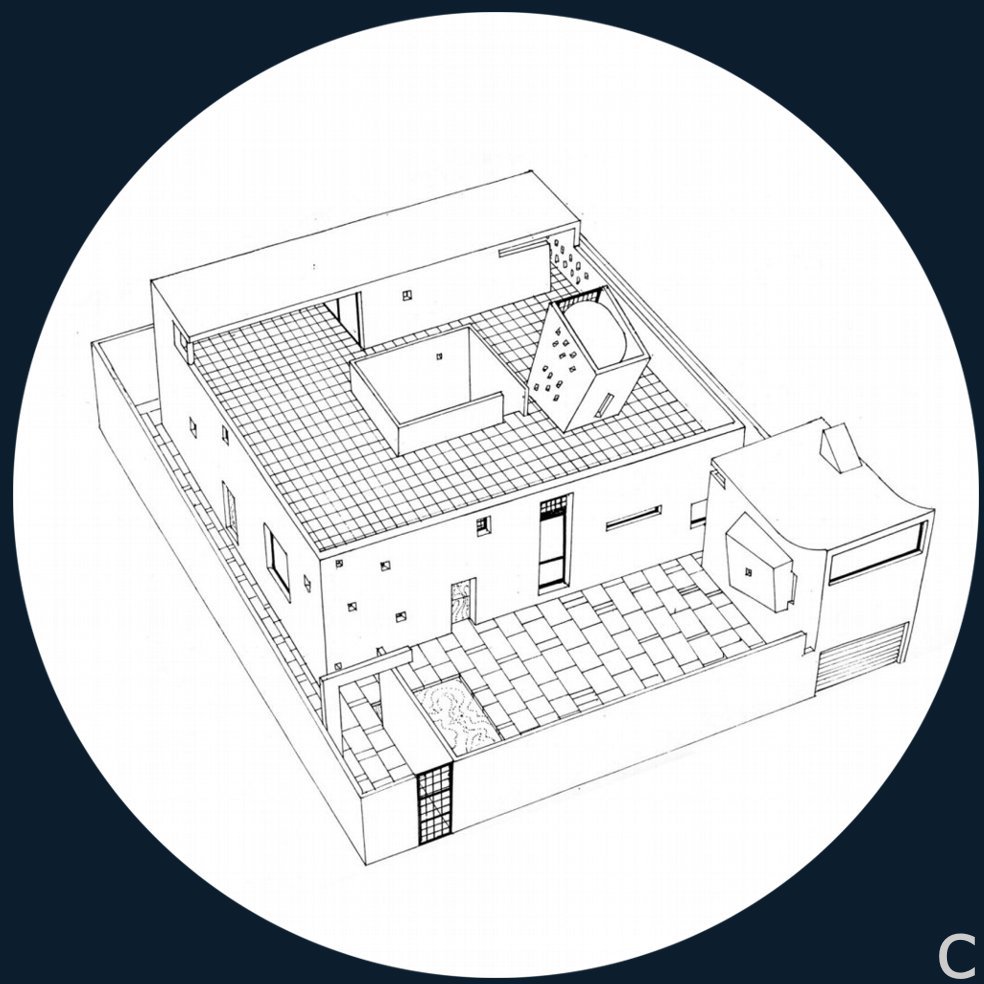
Establishing agreements for the houses.
In a letter written to us, Juan Domingo Santos meticulously described the intrinsic process for the exchange: The Cripple’s house, which was the catalyst for the whole procedure, had a small shed that was next to a patio. Adjacent to her, la Remedios lived in a house with a beautiful 19th century patio, with stone columns and wooden beams. To make her dream come true of owning this type of patio, the Cripple proposed to la Remedios to incorporate the patio to her house so she could use it as a walkway or a right of way. As an exchange, the Cripple would create in her new house a passageway next to the patio to benefit the house of la Remedios. It would be arranged in such a way that by uniting, they were connected to two streets at the edge of the block of houses, merely by crossing this passageway-patio space.
The solution was interesting for both parties, now that it made an elastic zone, which had up to then been very tight and difficult to access. Another agreement they came to, was to join the first two floors of each dwelling (very small) and to gain a larger floor space which could be rented out and thus, they could obtain an income that separately would have proved impossible. The benefits of this co-ownership were shared, depending on the degree of participation. Later, Carmela of the Dead, decided to participate in the exchange, after seeing the economic success and reward that these connections suggested for the houses (which enlarged substantially their surface through their patio). She offered her patio to form part of the passage which, in this case, connected to a square to which it faced. The result was very intriguing because the city, besides the movement through its streets, also possessed internal movements across its patios of different owners and, although being private, having the doors always open, any passer-by could make use of them.
To add to this exchange, the Cripple left part of her roof to become a sightseeing spot over the cathedral, which would benefit Carmela of the Dead, and she in turn freed a room with views towards the square for the Cripple. The result of all these changes permitted the Cripple, who originally had owned a small house, between neighbours and with a small patio without interests but with magnificent views over the cathedral, to finally share a traditional patio from 19th century Granada and one room with a view towards a square, with windows over other patios. La Remedios, in all this affair, also had a favourable result, the access to her patio had been improved, which up to then had been disconnected, and she had managed a change of ownership with Carmela of the Dead in a neighbouring house but closer to the centre, which she had been looking for.
“This game of exchanges and cessions has been left fractured partly because Granada’s town hall has bought the house of Carmela of the Dead to accommodate a few offices temporarily. As this occupation will be temporary, the Cripple, Carmela of the Dead, la Remedios and I are waiting for its removal to reinitiate this story. Disgracefully, Carmela of the Dead, paradoxes of life, was murdered by a client and let’s just see who is going to be the next owner whom we will approach to incorporate into the game,” said Domingo Santos.
This is an extraordinary project, which has emerged from the citizens’ conditions. Without a doubt, negotiation, as a concept, is already an architectural element. With it, new architecture is created which shows a special consideration towards its habitants, and refuses arrogant postures that have broadened the gap between society and architecture. In fact, as Juan Domingo Santos has confirmed to us, the expectations of San Matías neighbourhood have meant that many brothels have been bought and a change in profile in terms of inhabitants has begun to be felt in the recent years.

Captions:
a. Juan Domingo Santos (b. 1961) architect.
b. The project for these neighbouring houses accepted the present and its contradictions as a point of departure.
c. The elements, which have been interchanging during the last 15 years, include patios, a room with windows facing the square, views from a terrace towards the cathedral and the opening of windows over private patios.
d. The house of the Cripple was materialised bearing in mind the interests of the neighbours and the interpretation of the traditional patio house in this neighbourhood. For this reason, light is very important and creates changes in the space during the passing of sun- and moonlight.
e. The spaces were resolved without internal divisions in order to continue producing occupations or invasions of the neighbouring houses.
f. All the plans are open, with the staircase in one of the corners, as in the traditional patio houses of the neighbourhood.

HOUSE IN CORRUBEDO (GALICIA), BY DAVID CHIPPERFIELD


To integrate a house with its built environment does not assume a superficial mimic of the geometric forms that surround it. This house incorporates them in its form by reinterpreting the notion of dwelling by the Atlantic Ocean.

An author of prestigious architecture in Europe, Asia and America, the British architect, David Chipperfield decided in 1996 to design his family holiday house in a small fishing village in the North of Spain. It was in Corrubedo, the same place the legendary Spanish architects Manuel Gallego and Alejandro de la Sota used to spend their vacations. It was a place in front of the wild sea and unique dunes that represented a complete contrast to their hectic urban life in London.

Corrubedo
Both Chipperfield and his Argentinean wife Evelyn Stern had long been attracted by Spain. During the 10 previous years they had rented an accommodation in this small village in the south of Coruña region. Corrubedo, with only 726 inhabitants attracted thousands of visitors every summer who savoured its fresh seafood, fished sea-bass and bream and enjoyed its national park with a huge mobile dune of extremely fine sand.
Looking for a site for sale, the couple at last found one, like a gash in the main street and only a few metres from the sea. Although this first line of houses that was built in the 60’s had the possibility to open up towards the sea and the other side towards the urban life of the main street, due to the forces inherent in the sea the houses demonstrated a typology which displayed a preference for the city. All of them open their windows and balconies towards the street, however, they felt the need to protect themselves from the sea and thus reduced the openings to mere vents.
Having his own family as the client, Chipperfield enjoyed an exceptional freedom. Yet, for him, much freedom impelled him to redefine the working rules: What was to be interpreted? Rather than being concerned with a style or a shape, it was more relevant to think about the architecture from the inside of the house. That is, to reflect on the human condition and personal relationships that determine architecture, the connection between the inhabitant and the experience of the building. From the beginning, as with all his design work, Chipperfield therefore focused on creating spaces which situated the individual in relation to simple domestic rituals – having breakfast, reading a book, cooking and contemplating the sea. The architecture would become a setting without attracting attention, yet its presence should be felt.

Absorbing the powers of the sea
The sea became the central element for interpretation; its power and attraction should be enjoyed to the utmost during the family’s vacation. Consequently, and to the contrary to its neighbouring houses, the interior spaces of the dwelling must focus towards the bay and the harbour, protecting its privacy from the main street with a practically closed facade.
The house is elevated in four levels. A few metres from the beach, a ramp leads from the rocks directly to the children’s bedroom, rooms that resemble ship cabins. Above this floor is the living room, located such that a glass wall affords views out across the sea. On the floor above are more bedrooms and on the top is a terrace which, protected by the study, protrudes towards the Atlantic ocean like it covets the very essence of the sea. Any enclosure which might obstruct the vision is dissolved on the roof terrace where the family prepares a barbeque as if on a deck of a boat.
The memory of the village lies in the life around the ocean. In this setting, it is the sea which is the element that comprises the link between the past and living in the present. This powerful natural force also determines the exterior of the house, the selection of materials and the layout of the interior spaces. The solidity of the stone, which forms the base of the house, is reinforced by the weightless glass on the next floor, a sense of lightness which becomes more intense until making the house evaporate on the roof terrace.
Further responding to the sea, the house by Chipperfield manages to integrate itself with the same neighbouring buildings that had protected themselves from it. The house maintains harmony with the heights, materials and colours of these houses in the main street but instead of repeating their geometrical forms, it incorporates them through irregular lines which respond to the ever changing surface of the water and which accompany the skyline of Corrubedo’s front. It is a project which is born from incorporating the reflection of the visitor, the architect and his family in showing the attitude of being “a part of and yet apart from” their environment. For Chipperfield it was not a matter of inventing new forms but forming a dialogue between the place and the newcomers.

Captions:
a. David Chipperfield, architect (b.1953) (Photography: Nick Knight)
b. The holiday house in Corrubedo (2002). It took four years to be built due to hard climate conditions. (Photography: Hélène Binet)
c. From the living room the awesome sea is observed, sometimes surprisingly gentle, which has attracted the attention of many poets, painters and artists. (Photography: Hélène Binet)
d+e. The Atlantic architecture, different from the Mediterranean, encloses itself in order to protect the inhabitant when the weather conditions are hostile.
f. The use of modern technologies like aluminium façade systems that incorporate a high performance thermal break and sealed joints allow one to open windows when faced with the extreme Atlantic climate. (Photography: Hélène Binet)

FRANK GEHRY'S HOUSE IN CALIFORNIA


Before Frank Gehry acquired international prestige as the architect of the Guggenheim Museum in Bilbao, he designed his own house in Santa Monica (1977 - 78). The story starts when his wife, Berta, bought a small pink bungalow in a bourgeois neighbourhood. Gehry decided to redesign what he considered "a dumb little house with charm", to build around it and try "to make it more important". The result was so emotive among their neighbours that the new house was even shot at one night!

The neighbours' prejudice
The architect wanted to make the little pink bungalow look more important than it was by following the guidelines of Marcel Duchamp. His work had changed people's attitude towards ordinary and everyday things when displaying them as works of art. Gehry made an extension to the ground floor which wrapped the little house on three sides. The old house appeared, in that way, as a familiar object within the new house. The exterior of the original house was left almost untouched, even when parts of it were inside the new house. Its interior was remodelled considerably. In some places, it was stripped to lath and framing. In other places, it was repaired or retained. When entering the house, the distinction between the new and the old was emphasised as one had to pass through two doors - one designed by Gehry followed by the original door to the bungalow.
"I was trying to build a lot of ideas," recognised Gehry when explaining his project. In those days, in the years when he was short of money, he was fascinated with cheap materials like chain link fencing, plywood and galvanised corrugated iron. Enclothing the old house seemed a good opportunity to experiment with the mass produced materials that were not ordinarily used in the building of houses.
It was then when the neighbours approached him to say "We don't like your house" - to which he replied, "What about the boat that you have in the backyard … or the van? This is all the same, the same aesthetics." But they said "No, no, that is very normal." Twenty-five years later Gehry is still fascinated by such contradiction: "Everybody hates the chain-link fence but nobody sees it. What they see is a tennis court and a tennis court is a symbol of wealth."

The evolution of the family
One night when Arthur Drexler, then the director of the Department of Architecture at The Museum of Modern Art in New York, was invited to dinner at Gehry´s house, he asked questions about whether the pealed paint on the walls was intentional or not. At the end of the evening, Berta confessed to her husband that the guest had "thought the house was a joke". At that moment Gehry knew that his research had been successful.
The aspect of the house, with blurred edges between old and new finishes, gives the appearance of being a continuous building process. "We are in a culture made up of fast food and advertising and throw-away and running for airplanes and catching cabs - frenetic. So, I think that those possibilities are more expressive of our culture than something finished."
When Berta and Gehry made the house, they had only one child. Later they had a second one. The children grew and they too soon needed their rooms be refurbished. There have been many later additions, like the small swimming pool that Gehry had started dreaming of or the conversion of the garage into a guesthouse for two daughters from his previous marriage who often visited.
With these recent renovations "I lost the old house!", Gehry acknowledges, when referring not to the bungalow but what had been the revamped house in 1978. His house, which is in continuous transformation, tries to catch up with the rapid evolution of a family.

Photos: Frank O. Gehry & Associates.
Captions for illustrations
a. Frank Gehry (b. 1929) architect.
b. Berta bought "a dumb little house with charm".
c. Model of a possible evolution of the backyard.
d. First floor (1978). 1-Living Area. 2-Dinning. 3- Kitchen. 4- Bedroom. 5-Garage.
e. Second floor (1978). 4-Bedroom. 6-Closet. 7-Master Bedroom. 8-Out Deck.
f. Kitchen window.
g+h. View of the entrance (1978): the aspect of the house gives the appearance of being a constant building process.
i. With the extension carried out in 1993, many considered that the house had lost part of its original raw character.
j+k+l. NEW IMAGES OF FRANK GEHRY'S HOUSE (Dec 06).

CLOSED FOR THE HOLIDAYS


Happy reading!

THE HOUSE OF THE RAIN (SANTANDER), BY JUAN NAVARRO BALDEWEG


Returning from America, where he had spent five years researching art and architecture in the Institute of Technology Massachusetts (MIT), Juan Navarro Baldeweg received his first commission from his brother to design a weekend house in the hills of the Cantabria. The house is a manifestation of his conceptual investigations in America but, yet like a box of resonance, it needed an inhabitant to listen to it.

The materialisation of the investigations
Juan Navarro Baldeweg's brother wanted to enjoy family vacations in Alto de Hermosa in Liérganes. He had land which opened up to the green valley to the west, from where one could template the sea in the distance to the north. This project description would give the architect an opportunity to materialise his investigations from his broad conceptual education. Before becoming an architect, Juan had studied engraving at the School of Fine Arts of San Fernando in Madrid. This made him consider himself as much a painter as an architect. After finishing his PhD studies at the School of Architecture in Madrid in 1970, he left for MIT in Boston, USA. In 1977, he returned to the same School of Architecture in Madrid as a Professor of Design.
During his academic journey, Navarro Baldeweg reflected on and analysed certain essential forces in Nature - light, gravity, horizon, equilibrium, structures and the hand - which were realised in his different installations, paintings and later, architecture. The Slide from the exhibition Light and metals in Sala Vinçon in Barcelona in 1976 was, for instance, a game of equilibrium and instability, suspended in the air and ceasing the notion of time and space. Investigating further the field of perception, the installation boxes, Five Units of Light from 1974, construct and give shape to the trace of light in a natural environment. Applying this research, Baldeweg moved between sculpture, painting and architecture and aspired to experiencing space and the environment through relationships with human feeling and thinking.

The House of Rain
The House of Rain (1978-1982) draws its name from the climatic conditions that surround it. The stratification of building materials - stone, glass and zink - creates the impression that the rain transforms the house; dressing it, changing its textures and colours, resounding in it. This idea was already present in an installation in 1979, which formed part of the project. It was a small model made in copper of a house with a pitched roof and big gutters over which a coil sprayed fine rain. Appearing as if the water “combed” the house, the eye of the spectator sensed a relationship between the form, space and the different textures of the water left behind.
The design of the house acquired a U- shape with its two arms gently open as a gesture to embrace the valley. The link with the landscape was reinforced by separating the structure that holds the house from its enclosing walls, thus allowing a line of windows to run along the facades with the vision uninterrupted towards the horizon. Using architectural references, like interior perspectives by architect Baillie Scott (1865-1945) where windows were placed at eye level, Navarro Baldeweg also showed a commitment to functionalism and the poetics of space.
Tracing the road that surrounds the house, the visitor finds an entrance characterised by two blind and slightly curved walls. Instantly, the absence of a reference drawing out the horizon produces a certain feeling of oppression and makes the eye move and look for limits. At this point, the project anticipated that one would see three glass boxes, which were intended to organise and display overcoats, books and tableware, respectively. The glass boxes acted as mediators between the inhabitant and nature. Their slightly fan-shape layout composed the space and guided the visitor in his study of time to reach the infinite space by the horizon that was framed by a pergola situated in the garden. It was here that the eye could finally rest and contemplate the line of the horizon. But at moment of rain, this line would dissolve again and give way to a soft sound from the roof.
Through enlarging the scale of the first house in copper to make it into full scale architecture, Baldeweg introduced the notion of the client; his perception of entering a space and organising his belongings and memories within the landscape. Although the glass boxes were never built, the architect offered the possibility to fuse the daily life with the furniture, architecture and landscape. He imagined a house which acted as a resonant box. As he himself explained to us; "the instrument and the music are not the same thing. Nobody makes a musical instrument with the object itself. The experience of the architecture is like listening to music." When resounding, architecture encourages us to establish an agreement between the physical and the sensual. As such, the House of Rain is only fully perceived when inhabited.

Captions for illustrations:
a. The painter and architect, Juan Navarro Baldeweg (b. 1939). (Photographer: Pablo Fernández Lorenzo)
b+c. The House of Rain, installation. 1979.
d. A sketch of the House of Rain on a white background (1979). Pencil drawing, 30x40 cm.
e. Appearing as if the water “combed” the house, the eye of the spectator sensed a relationship between the form, space and the different textures of the water left behind.
f. Ground plan of the House of Rain (1978-1982).
g. View towards the north. (Photographer: Churtichaga, Estudio JNB)
h+i. The design of the house acquired a U-shape with its two arms gently open, as a gesture to embrace the valley.

THE ICON HOUSE (MONTREUIL), BY PÉRIPHÉRIQUES


Not only promoters and private clients question architects’ abilities to design economic, yet high quality, houses. The young Paris based architecture office, Périphériques, have researched into the idea of the model house and produced the Icon House, which aims to satisfy the expectations of both the client and the architect.
Although originally the house was born without a client - in fact, its source is based on the collective idea we all have of what a house is: a construction of four walls with 45º sloping roof - the model is able to offer different to versions that meet our personal characteristics.

36 Proposals for a Home
Périphériques decided to share their investigation with other young European architects. They asked almost forty teams to submit a project for a model house, of 80 square metres with a budget not exceeding 80.000 Euros, including the salaries of the architects. The end result was an exhibition, 36 Proposals for a Home, held at the Arc en Rêve Centre d'Architecture Bordeaux in the autumn of 1997. Each one of these 36 projects proved that it was possible to propose interesting schemes with a low budget. Many of them managed it by diverting standard contemporary materials from their original industrial purposes and using them for domestic designs.
The group Périphériques insisted on the very important role the exhibition would have as a pedagogical experience for the general public. It travelled from Bordeaux to Barcelona, Glasgow and Paris, Besancon and Marseille, art centres and home architecture shows. Additionally, it was accompanied by an illustrative catalogue of which more than 10.000 copies were sold. Nowadays it is very hard to obtain one. Consequently, the investigation became known to a large audience who responded with hundreds of letters together with several commissions. Now, the exhibition forms part of the historical architecture collection at the Georges Pompidou Centre in Paris.

Your House Now
Five years on from the exhibition the group Périphériques published Your House Now, a second book which illustrated 12 of the projects now built as homes and indicated where one could find The Icon House by Louis Paillard and Anne-Françoise Jumeau.
The architects made the icon of a single-family house their starting point and used that preconceived image as a building component. Following this symbol, the house could be wrapped with wood, mortar, wire mesh, polycarbonate or whatever other material, depending on the budget and the taste of the clients. Moreover, avoiding the presence of elements like drainpipes, chimneys, balconies, or the dividing line between the facades and roof was a way of transforming a normal house into a surreal dream that retained its icon.
The interior of this volume was determined by the maximum width of a 6 metres beam which allowed an economical unsupported span. In that way the structure became a shell that permitted flexibility in the interior to arrange the rooms. This was something which was already implicit in the exhibition where five versions of the interior layout for the Icon House were presented with the aim to encourage future inhabitants to personalise their spaces.
When the catalogue of the exhibition reached the hands of Véronique Decker and Emmanuele Derid, a couple highly involved in politics and consequently with a great capacity to negotiate, they decided to interview several of the architecture offices that had participated, with the aim of selecting designers for their new house. After series of meetings they chose the Icon House because, although it was a project for a “normal house”, it was not totally pre-determined. Furthermore, their relationship with the architects, already stated in the commission contract, was based on negotiation following the rules created by the icon.
The family had a 522 square metres land in a working-class district in Montreuil, a town 5 minutes east of Paris. The conditions were nothing out of the ordinary. Their needs matched those of many other families: a big living room, five bedrooms, a kitchen, a study and a bathroom, all surrounded by a garden, as big as possible, and with a garage.
They talked about the skin of house and the feelings they had about the wood. As if it was about building these conversations, the garden facade was built of phenolic wooden panels with diamond imprints which reproduced the wire mesh pattern that covered the rest of the house.

A big garden over the house
These claddings and plants that cover and climb the roof and the walls make up a big garden which covers the house, hides gutters, drainpipes and vents and they transform it into a huge mystery. Inside the house, this same feeling appears in several details such as where plants cover small openings and where there is no need for curtains, or in the appearance of monumentality that is bestowed on the depth of the window frames and of the doors which exceed the thickness of the wall reaching the exterior space right to the metal mesh.
Although Périphériques designed the Icon House by responding to the question of collective memory - introducing the restrictive economic factor that affects the choice of cladding materials and the distribution of space - the final result responds to our particular icon of how one lives.

Captions for illustrations:
A. Louis Paillard (b. 1960) and Anne-Françoise Jumeau (b. 1962), members of the architectural group Périphériques, founded with Emmanuelle Marin and David Trottin in 1996.
B. The claddings and plants create a big garden that covers the house and transforms it into a huge mystery.
C. As well as exceeding the thickness of the wall, the depth of the window frames and of the doors reaches the exterior space right to the metal mesh.
D. The garden facade was built of wooden panels with diamond imprints which reproduce the wire mesh pattern that covers the rest of the house.
E. The Icon House (2002) is one of the many variations of the project presented in the exhibition 36 Proposals for a Home.
F. The clients had wished for a big living room and a kitchen downstairs, which were connected to the bedrooms overlooking the garden in the back with a combination staircase/furniture in wood.

VILLA EILA IN GUINEA, BY HEIKKINEN + KOMONEN


Eila Kivekäs, a Finnish anthropologist and a founder of a development association in West Africa, commissioned the architects Heikkenen + Komonen to design her house in Guinea. The selection of a Finnish studio was not that surprising, what was surprising was that she chose a practice renowned for its highly technological architecture. Markku Komonen y Mikko Heikkinen had gained an international recognition for sophisticated buildings that ranged from the MacDonald in Helsinki, the airport terminal in Rovaniemi to the Finnish Embassy in Washington. Despite this vast cultural difference between the work of the architects and the reality of Guinea’s republic, the line of thought that the architects followed made Eila burst into tears when she saw her house finished.

Eila Kivekäs (1931-1999)
Eila Kivekäs 's life was intense right to the moment of her death in 1999 which happened when she was celebrating the tenth anniversary of the Non-Governmental Organisation she had set up to aid the development of Guinea. Her grandfather, a village shoemaker, had discovered a pair of factory-made shoes in a shop. So intrigued by the construction, he bought them and analysed in detail the manufacturing technique. His insight led to the establishment of Finland's footwear manufacturing industry. A hundred years later, his grand daughter used the wealth from this innovation to aid the development of Guinea, an impoverished country and a former colony where the expected average life expectancy was 40 years.
It was the Guinean scholar Alpha Diallo who aroused Eila's curiosities and interest for Africa. They met when the Finnish literature Society invited him to speak about his translation of the Finnish National epic Kaleval into Fula language. Unfortunately, Diallo died prematurely during his visit to Finland. Eila personally organised the return of his body to Guinea for the funeral. She travelled there and on her return organised various exhibitions on different themes on West African culture.
In 1989, impulse lead to her founding the development association Indigo based in the town of Mali. This was a town of a thousand inhabitants surrounded by the Futa Djalon Mountains in the North-East of the country. In respect for local tradition, Eila opted for Indigo to represent the spirit of the association - the traditional indigo dyeing of textiles, where men weaved the textiles and women dyed them. The role of the association was to elevate women's status and the development of professional training, to educate and co-operate with local people about health care, hygiene and nutritional information.

Villa Eila
The choice of the architects, Mikko Heikkenen and Markku Komonen was determined by their conscientious meeting of different cultural settings. Besides understanding their architecture, Eila knew the two architects personally from the early 1980's when they had shown incredible sensitivity in converting her grandfather's large house into a cultural centre. A few years later, when she became established in her field work in Africa, Eila asked them to design a small home with basic facilities that included two guest rooms. The site she had was situated on a slope facing west on the outskirts of Mali.
Working on the project, the architects felt obliged to become familiar with West African culture and climatic conditions before defining the design. They realised that in spite of poor economic conditions, there was already a great concern for protecting the environment and the promoting of local building methods. Although burning trees was widely used for making bricks and clearing land for cultivation, it was illegal in Guinea. It caused a great threat to the whole ecosystem. Furthermore, importation of materials and heavy transportation had to be kept to a minimum although, paradoxically, concrete and metal plates had, despite their expensive and bad thermo-technical properties, gained popularity and respect in many large population centres.
The most ecological material used by Komonen and Heikkinen was stabilised earth, or uncooked compact earth. The process consisted of adding 5% of cement to the earth as a bonding agent to reach an exact state of moisture and then the building blocks were pressed manually in order to construct walls. This local material benefited from the local skilled labour available almost everywhere and required no wood for burning and no need for electricity during the building process. The roof tiles of the dwelling, only 8 mm thick, were made from the same kind of mixture although reinforced with added fibreglass. Floors were covered with terracotta tiles made by local women skilled in pottery; the long eastern facade was constructed of traditionally woven bamboo while the western enclosure was terraced with stone-walls and planted with fruit trees and blooming bushes.
In the same way as Eila Kivekäs had become impressed with the land and people of Guinea, the architects were receptive to the characteristics of the site. All the rooms were organised as independent units with porches in between them that opened to the mountainous western horizon and unified with a roof plate parallel to the slope. Far from imposing post-industrial European values, this architecture of assimilation and crossbreeding, prevented any exclusion and used existing resources in order to preserve the culture and costumes of the place.
Villa Eila conveyed the importance of context, of using what was available in each place - in materials, skilled labour and the familiar. It showed how the knitting of materials and spaces, qualities and textures of each built element, transmitted a way of life and culture, so noble and foreign to our western conditions, so receptive that it generated a whole set of emotions.

Photographs: Heikkenen+Komonen
Captions:
a. Mikko Heikkenen (b. 1949) and Markku Komonen (b. 1945).
b+d. Under a roof plate parallel to the slope, the rooms of the house are arranged in different units with a cross ventilation.
c. Traditional skilled local labour made the stabilised earth.
e+f. The east facade acts as a veil made of interwoven bamboo which filters the morning sun.
g+h+i. The interior spaces of Villa Eila (1995) are as noble as the objectives of the Indigo association.

VILLA BOLLEN IN HOLLAND, BY ONE ARCHITECTURE


It happened just over twenty years ago, the Bollen family had a parcel of land near Eindhoven and knew exactly what they wanted: to follow the fashion then in Holland and to build a French-style country house. But, as time passed, the family grew ever more dissatisfied with the house and even took to sleeping outside in the open air. The Bollens realised that what they needed was not a “style” house, but a house that intensified their relationship with nature.

A “style” house
The house that the Bollen family had built fulfilled every element of a French-style country house: the façade built in red-brick façade and the painted white, small-pane windows and garrets - all under a tiled roof. To prevent neighbours building an eyesore that would spoil this desired composition, the family began buying lots adjoining their garden until, eventually, their land joined up with a nearby nature reserve. It was then that the Bollens hired a landscape designer to lay out the garden. He played on the different qualities of the grounds – such as a slight slope and sandy soil - and created several perspectives, alternating free and ordered plantings laid out in a fan, none of which formed an axis with the house. As the family started feeling almost claustrophobic in their home, they found themselves spending more and more time in nature - almost without realising.
The Bollens decided that what the house needed was an extension that would open up to the garden. In 1997, they contacted the Dutch architecture firm, One Architecture. To inspire the design of the extension, One Architecture prepared a brochure of different houses by prestigious contemporary architects - many of whom will already be familiar to the readers of Stories of Houses such as Rem Koolhaas, Frank Gehry, Ben van Berkel and Alvaro Siza. The brochure also included historical figures that ranged from the classical Andrea Palladio to the modernist Mies van der Rohe. Although the Bollen family did not identify itself with any of the houses, it appreciated the Farnsworth House by Mies van der Rohe because it seemed to embrace its entire surroundings. This was exactly the type of house that they wanted to learn from.

The history of the Farnsworth House
In 1945 Edith Farnsworth, a physician, approached the Museum of Modern Art in New York for advice on finding an architect to design her weekend country house. The names she was given were: Frank Lloyd Wright, Le Corbusier and Mies van der Rohe. In the end, Dr. Farnsworth chose Rohe, and showed him the four hectares of land that she owned in Plano near Chicago, on a slope descending to the Fox River. The land was characterised by flat meadows broken up by a group of trees, including two enormous sugar maples. Furthermore, an important factor to bear in mind was that the land was regularly flooded, due to its low position in relation to the river.
The architect built a glazed box of 23.5 x 8.5 m, set on a floating steel structure and elevated 1.5 m above the ground on eight steel columns painted white. In order to respect the trees, the house was carefully placed among the sugar maples and oriented with its long axis in an east-west direction. The steel structure was placed directly in front of the glass façade so that nature and severe contrasts of the seasons were experienced with intensity, and formed part of the human environment equal to the built house itself. In this open space, the kitchen appeared as one piece of furniture - something that is recognized nowadays - and in that way enjoyed impressive views just as the living room did. Despite this "ideal" solution, Dr. Farnsworth took Mies to court, accusing him of overspending on the construction and describing how difficult it was to live in the house. However, despite a three-years fight, she lost the lawsuit.
From this point of view, it is ironic that the Bollen family chose a house that its original client had accused of being "inhuman". But, fifty years on, the role had been reversed. The atmosphere of the Farnsworth House was now seen as desirable, all because of its intense relationship with nature.
Matthijs Bouw, co-founder of One Architecture, interpreted the Fansworth House and took elements from Mies' work: the open plan, the border finishing of the roof, a replica of the chromium cruciform column from the German Pavilion at the Barcelona Expo of 1929 - even elevated the extension by half a metre so that the large scale of the open plan allowed the eye to pass through the building and traverse the entire depth of the garden and landscape. The façade’s stainless steel sliding doors create the effect that the extension is like a pavilion in nature where, from the inside, one can breathe the scent of the trees and feel the warm breeze stroking one's cheeks. Can one therefore talk of a style? Looking at this house, one realises that the architecture disappears: what matters is the closeness of nature.

Captions for illustrations
a. Matthijs Bouw (b. 1967), architect and cofounder of One Architecture.
b. After the lawsuit, Edith Fansworth sold her house to the young British millionaire Peter Palumbo who had commissioned Mies to design an office tower in the City of London, which would not, however, be built until after his death when the lease for the site would be available. When the time came, Palumbo applied for building licence but the project was rejected by the government headed by historical conservationists, a contradiction, as Mies formed part of history by then.
c. The sectret to building the extension to the Bollen House lay in One Architecture being able to reinterpret the Farnsworth House.
d+e. The Bollen House (1999).
f. At night, privacy is provided by curtains in strong colours that are designed by the artist Berend Strik. The fabric originated from Mr Bollen's own fabric factories in Asia.
g+h+i Developing the design for the extension, a few elements were borrowed that were characteristic of Mies’s work: the open plan, the border finishing of the roof, a replica of the chromium cruciform column from the German Pavilion at the Barcelona Expo of 1929 - even elevated the extension by half a metre above the garden.

HOUSE IN LA MORALEJA (MADRID), BY MIGUEL FISAC


It was at the beginning of the 1970’s when the engineer Pascual de Juan Zurita decided to build a house in a wood of oak trees close to the airport of Barajas North of Madrid. He chose the architect Miguel Fisac, who was then well known for his many patents, more than a hundred newspaper articles, numerous lectures, and had already built a substantial amount of work.
Despite the modest commission, the client managed to persuade the famous architect. Fisac accepted with the condition that he could respect the oak trees to the maximum and could take this opportunity to research further with his inventions and with the engineer’s knowledge about the use of the concrete.

The development of the architect
It is difficult to understand the powerful expression behind Fisac’s work without making reference to his life. Within that context, it seems paradoxical that in the many texts written about him on the occasion when he won the National Prize for Architecture (2003) or when he had received the Golden Medal for Architecture in 1994, no reference was made to the close relationship between the evolution of his work and of him as a person.
From a very early age, Miguel Fisac had undertaken a search for personal references. He combined his architecture studies, which were interrupted by the Civil War, with a deep search into the Christian Spirit. At that moment architecture mainly emerged as a question of monumental styles that mourned the Spanish Empire. When in 1942 Fisac graduated from the School of Architecture in Madrid, he told us that “as we were only ten who graduated, there was a lot to be done. A month later I was commissioned a work and I plunged in without thinking.” Already in his first project, to transform a lecture theatre into a chapel dedicated to the Holy Spirit, Fisac started his experimental research. Very soon he gained experience from the huge amount of work he had, “because there was nothing”, putting into practice his innumerable inventions: Fisac’s brick, his first patent from 1951, which managed with its inclination to hide the joint to the next one in order to seal and isolate more efficiently, his window systems, the concrete “bones” (structure), the stands for lamps and furniture and the flexible moulds made of plastic and rope that gave the concrete a soft aspect. The 1950’s was a period of intense activity which came to revolutionise the facets of the Spanish churches, until in 1955 when he left Opus Dei. That same year Fisac started his journey alone around the world. It was as if he was embarking upon a new search for references, visiting many works of architecture. Disappointed by the purist vision of the Modern Movement, which Fisac criticised as being “inhuman rationalism”, it was in this journey that he discovered Asplund’s work and Japanese architecture.
By continuously rethinking, Fisac formulated a methodology of how to start a project. With the questions: What for? Where? How? as well as an “I don’t know what”, he started a series of reflections which had to be responded to in order to achieve a work of architecture.

A mental itinerary for designing the project
What for? The brief asked for a house for a couple with seven children and Pascual’s mother.
Where? Before drawing or deciding on building materials for the house in Moraleja, it was important to study the wood of oaks that grew on the 2600 m2 site. It was a site, which also at the time of the commission, was affected by busy air traffic from the airport of Barajas that passed directly over the land.
How? Fisac drew the plan of the house respecting the beautiful oaks. From the entrance hall, one is led into a big common space, which is without any partition walls but organised by the soft curves of the facade. It consists of a living room and an area for conversations and listening to music by the chimney, both with a view to the south. At the other end, with a view to the north towards Guadarrama, there is the area to play bridge and the dining hall. From here one has a direct access to the nucleus of the kitchen, a laundry and an ironing room, the servant’s bedroom and a patio, which has an independent entrance and includes the laundry line. Privacy for the office and the family’s bedrooms was achieved by a covered patio. Due to the inclination of the site, the access to the basement is also at ground level. Here the garage, the chauffeur’s bedroom, a play area for the children, and changing rooms for the swimming pool were arranged.
To enclose these spaces, Fisac made use of one of his inventions which enlisted the flexible qualities of the concrete. In the house in La Moraleja, white concrete was poured into flexible plastic moulds in order to transmit the quality of the paste and weight of the concrete, leaving its tactile appearance soft and spongy. Additionally, these concrete panels were especially designed so as to incorporate double-glazed windows that were fastened with neopreno and thus they would be sound proof against the noise of the flying aeroplanes.
“I don’t know what”. Despite the reconstruction after the fire in the house in 1997 and the recent alterations which the new owners did without consulting the architect, the house maintains the powerful plastic qualities of the concrete and the technical solutions of air tightness. Different tones of greens and browns from the oak trees draw out forms and textures changing with the rays of the sun and project onto the cedar walls and openings as well as onto the white concrete walls. What Miguel Fisac designed for the enjoyment of the family was “a fraction of humanised air.”

Photographs: Studio Miguel Fisac.
Captions:
a. Miguel Fisac (1913-2006) received Golden Medal of Architecture (1994) and Spanish National Prize for Architecture (2003).Working on the article, we visited the architect on various occasions to his house, Cerro del Aire. During these conversations, at the age of 90 yet with a very lucid mind, Fisac explained this work to us by making reference to his lifestory.
b. The exterior of the house is clad with prefabricated pieces of white concrete from flexible moulds, according the patent of the architect, with ventilation openings and walls finished with cedar wood.
c. Ground floor of the house in La Moraleja (1973).
d. The technical solutions have led to the formal solutions of the house.
e+f. The padded aspect of the concrete is one of the unique possibilities that the material offers:”When the concrete has nothing which disturbs it, what form will it take? It is the only material which is poured soft into a mould. Well, it should leave some traces of it having once been soft.”

THE STRETTO HOUSE IN DALLAS, BY STEVEN HOLL


The Stretto House (1989 -1992) in Dallas, Texas, was designed by the American architect Steven Holl for clients who had an extraordinary art collection and a beautiful site. They did not impose any conditions onto the architect but told him; "you can do what you want." What was the respond to such a freedom?

Looking for a story of the house
Right from the beginning of the project, the Stretto House was ideal. To start with, one of the clients had been brought up in a house designed by the mythical figure, Frank Lloyd Wright which meant that the client had already inherited from his family a love for architecture. Furthermore, when Steven Holl visited the site on which he had to work, he found himself in a landscape characterised by a river that fed three ponds, each contained within small concrete walls over which water flowed, making a constant murmuring sound.
Talking to one of his students, who also had been a student of the prestigious Juilliard School of Music in New York, Holl asked if he knew any musical composition that was structured in parallel to the water that flowed on the site. The student told him about the "Stretto" form where one musical phrase overlapped another. It was then that the Music for strings, percussions and celesta written in 1936 by the Hungarian composer Béla Bartók came to their mind. This piece of music was divided into four parts and characterised by overlapping percussions (heavy) and string instruments (light). Powerful flows of rhythmical divisions and irregular tensions made time seem to stand still or to rush forward with irresistible momentum.
It took the architect six months to come up with a sketch to a house which was structured around this four-part musical composition. The challenge came in maintaining and materialising in the construction of the house as an idea of an aqueous space.

The music of the Stretto House
Steven Holl admired the connections between the traditional and the modern in Bartók's music. Similarly, as Bartok's extraordinary compositions reverberated original melodies, the Stretto house built an aqueous space with traditional materials, its polished concrete blocks and metal structure forming part of Texas's vernacular architecture. These traditional materials were used in all four sections of the house, each of which is divided into two units: the first is rectangular heavy masonry which makes reference to the concrete dams on the site, and the second is of light and curvilinear metal which covers the various rooms - living room, art storage room, office, dining room and breakfast corner. Each of the rectangular masonry contains a service zone for the house - the staircases that lead to a bedroom and a sitting room, bathrooms, library and the kitchen. The last section of the house is a partially covered pond, a flooded room.
The approach to the house via a driveway bridging the stream gives access to a stone courtyard with a fountain. Immediately upon arrival at the house, the overlapping of spaces occurring in the house is revealed. If the plan is orthogonal, the section is curvilinear. In the guesthouse this interplay of straight and curved was reversed, similar to the inversions of the subject in the first movement of the Bartók's Music.
The "Stretto" form enabled Steven Holl to divide the space in such a way that each part was important for the next. The flow of the space evolved in different ways: the floor surface overlaps the next level, the roof overlaps walls and the curvilinear walls pull the daylight down into the interior space. The water - which flows over the dams and seems to symbolize the overlapping of the Stretto form - also takes part in this game, as it serves to reflect in the landscape the overlapping taking place in the interior space of the house.
In the Stretto house Steven Holl appeals to the senses and plays upon artistic perception and understanding of the site. It is the pleasure of experimenting architecture with spatial and light sequences, textures, smells, and sounds.

Photos: Paul Warchol
a. Steven Holl (b. 1947) architect.
b. Stretto is an Italian term which, in a musical context, talks about the emotional tension that is intensified by means of an overlapping of instruments. Music for strings, percussions, and celesta by Béla Bartók (1881 -1945).
c+d. Drawings of Stretto house; a work that received the Honorary National Prize (1993) from the Institute of American Architects.
e. Plan of Stretto House's ground floor: 1. Terrace, 2. Garage, 3. Entry, 4. Living room, 5. Art storage room, 6. Library, 7. Study, 8. Dining room, 9. Breakfast area, 10. Kitchen, 11. Garden, 12. Pool, 13. Flooded room.
f. Formula for music and architecture interpreted by Steven Holl: Material x sound/time = material x light/space.
g. The model shows the relationship between the house, the dams and the guesthouse.
h. Steven Holl was nominated by the Time Magazine as the best American architect "for buildings that satisfy the mind as well as the eye”.
i. Influence from the music is found in the furniture. Woollen carpets were designed with musical scores and float on the glossy black terrazzo floors.

DICK’S HOUSE IN TROYES (FRANCE), BY JEAN NOUVEL


One of the first commissions that Jean Nouvel received can be traced to 1977, when a gynaecologist who was enthusiastic about architecture asked him to design his house. The client’s enthusiasm ensured that from the very beginning this would be an intriguing collaboration throughout the design process. The young architect responded positively to this request, intense conversations were had with the family about how the house might be.
Through dialogue a project emerged that everyone was happy with, yet unfortunately it did not obtain a building permission. The project was described by the local building authorities as a pastiche which did not integrate with the existing environment. Although the architect had to accept the imposed changes, he took advantage of the existing situation, creating the final image of the dwelling.

Towards a “critical architecture”
From his student’s years, Jean Nouvel was convinced that one could only practice architecture by following a personal commitment. He had taken an active part in the students’ revolts of May ’68. He was also instrumental in the outburst at École des Beaux-Arts, where young architects demanded a redefinition of the profession, celebrating a dialogue with the user and encouraging a democratic process when developing a project. In that way, the students questioned the type of architecture that was being made and what it could turn into. In this context Nouvel’s position was clear: to look for freedom away from the architectural discipline and to adopt an attitude of being sceptical and questioning; to listen and to make use of contradictions and characters of every situation and place.
To obtain this freedom, Nouvel’s critical dimension of architecture could not limit itself to theoretical texts or paper architecture. It was necessary to support his polemic position concerning themes related to architecture and the city by going as far as to wish for a change within the majority of the laws that regulated the building construction. Nouvel was one of the founding members of Mars 76 and the Architecture Union in 1976. Furthermore, he organised an unofficial architecture competition for the redevelopment of the Le Halles neighbourhood.
Nouvel with his partners, published manifestos, turned to the street on various occasions, fought against the narrow corporate nature of the profession, challenged zoning and the regulations concerning the occupation of the terrain which expressed technocratic vision which was short of humanism in terms of urban planning. Nouvel’s militant activity has always involved fighting against any obsolete norms.

The construction of the house
This was the historical context in which Mr Dick commissioned Nouvel to design his house.
The site was in the medieval city, Troyes, located in the Champagne region of France, South East of Paris. The city is now a famous tourist attraction where its narrow pedestrian streets are lined with half-timber framed houses. Troyes is also known as the holy town of stained glass, which adorn the 10 churches in the city centre, as well as containing the most ancient civil building in France that still remains devoted to wine.
The collaboration between Dr. Dick, his family and Jean Nouvel was intense. They spent long evenings defining the most suitable living spaces for the different members of the family. They decided to give the main living spaces one volume, which, according to a logical programme, included a number of vaults. In this way, the ample living room was located under a white painted barrel vault but also, the architect created a spacious play area for the children where each one had a small apse that was intended as a warm and secure bedroom.
Submitting the result of their conversations to the department of administration, the office denied the project a building licence on the grounds that the design was a pastiche of Byzantine architecture, thought to be out of context with the medieval city of Troyes. The report was demoralising and accused the house of not integrating with the environment, an environment which according to Nouvel “consisted of a disorderly mixture of neo-regional copies and apple green supermarkets.”
The architect complained to the town hall, he wrote to the president of the regional committee, and even to the minister of housing, but to no avail. Worn-out of fighting, Nouvel had no choice but to introduce the changes and additions requested for the facade, although he made no modifications in the interior.
Throughout this endless process, Nouvel took every available opportunity to make his cultural position explicit. He applied again for the building licence presenting plans that were so brief that they managed to confuse the administration. The project was accepted and the building work started. He took advantage of their confusion, creating a final external image for the house which incorporated the footprints of censorship within the building facade. Nouvel marked this episode of the censorship and deadly norms with a line of red bricks that traced the changes he was forced to make on the facades. As well as being a new home for the Dick family, it proved to be a statement of a personal definition for the architect and of the client, in refuting any questions of style or norms, pleading for an architecture that was rooted in cultural values and a dialogue.

Photographs: Nouvel Atelier
a. “The task of architects is precisely to create a cultural definition of the built environment.” Jean Nouvel Jean Nouvel (b. 1945). (Photograph: Gaston).
b. Dick’s house (Troyes, 1978) was the first project realised by Nouvel that could be called “critical architecture.”
c+d. The intense conversations between the architect and the doctor brought about the project that the client wished for but did not obtain a necessary building permission.
e. With the client’s help, the dwelling spaces were defined and adjusted to meet the different requirements of all members of the family.
f+g+h. Although the architect had to accede to the imposed changes, he took advantage of the situation in order to create the final image of the house and to leave footprints of the censorship on its facades.
i. A line of red visible bricks traces all the footprints of the censorship and the obsolete regulation which it stands for.

MÖBIUS HOUSE IN AMSTERDAM, BY BEN VAN BERKEL


In 1993, a young couple commissioned the Dutch architect Ben van Berkel to design "a house that would be acknowledged as a reference for the renovation of the architectural language". It took the architect six years to fulfil his clients' wishes, creating a house based on the studies of a 19th-century German mathematician.
Curiously, the spatial concept of the new Mercedes-Benz Museum in Stuttgart - a radiant work by Ben van Berkel - demonstrates how the architect has drawn on and experimented with his memory of the Möbius House.

A new architectonic language
In addition to their wish for a new architectural language, the clients looked for an intense relationship with the landscape, as their two distinctive professions allowed them to work from home and therefore to spend more time with their children. The chosen site was amongst meadows and tall beech trees in Het Gooi, a residential area near Amsterdam.
Ben van Berkel understood that the new architectural language he was asked for should be a direct consequence of their new way of life. The idea of two people moving along their own routes, but sharing certain moments - possibly also reversing roles at certain points - was elaborated into the built object. The house had to knit together the different activities which each member of the family was involved in at different times into one structure: work, sleep, socialise and family life, as well as the need to be alone. Thus the notions of time and duration were important concepts right from the beginning, and ones which would later influence how the house and its objects would be perceived from different viewpoints.

Diagram of 24 hours of living
The scheme to convey these features was found in the Möbius band, a diagram studied by the astrologist and mathematician, August Ferdinand Möbius (1790-1868). By taking a rectangular strip of paper and marking its corners, A -superior- and B -inferior- in one side, and C -superior- and D -inferior- on the other, the Möbius band is constructed by twisting and joining corners A with D, and B with C. The result is a strip of twisted paper, joined to form a loop which produces a one-sided surface in a continuous curve. It is a figure-of-eight without left or right, beginning or end.
By giving the Möbius band a spatial quality, the architect has designed a house that integrates the programme seamlessly, both in terms of circulation and structure. Movement through this concrete loop traces the pattern of one's day activities. Arranged over in three levels, the loop includes two studies (one on either side of the house for the respective professions), three bedrooms, a meeting room and kitchen, storage and living room and a greenhouse on the top, all intertwined during a complex voyage in time.
With its low and elongated outlines, the house provides a link between the different features of its surroundings. By stretching the building's form in an extreme way and through an extensive use of glass walls, the house is able to incorporate aspects of the landscape. From inside the house, it is as if the inhabitant is taking a walk in the countryside.
The perception of movement is reinforced by the changing positions of the two main materials used for the house, glass and concrete, which overlap each other and switch places. As the loop turns inside out, the exterior concrete shell becomes interior furniture - such as tables and stairs - and the glass facades turn into inside partition walls.
The contortions and twists in the house go beyond the mathematical diagram. They refer to a movement that has moulded a new way of life as a consequence of using electronic devices at work. Ben van Berkel has managed to give an additional meaning to the diagram of the Möbius band, where its new symbolic value - characterised by the blurred limits between working and living - corresponds to the clients' way of life.

The house as an architectonic reference
The concept that generated the Möbius House did not expire with being built. Instead, it became further developed in the architect's mind and now, in the new Mercedes-Benz Museum in Stuttgart, illustrates the history of cars.
With the aim of creating a museum that could be read as an urban space where the car is the protagonist, van Berkel drew three loops in section that were entwined in plan, just as if they were leaves on a tree. In doing so, he managed to achieve variations between the different levels, to challenge both the symmetry and the flatness of the floors, and to create a wide range of paths and shortcuts, such as those found in cities. The leaves of the tree are turned around a triangular void, producing six platforms which make up spaces of varying heights and creating a dynamic exhibition space.
Although the museum is on a much bigger scale than Möbius House, its spatial effect reminds one of the house. For the house, the Möbius strip suggested a plan that interlaced the different movements and activities of the family. For the museum, the trefoil offers a movement between forms of continuity and cross references, between open and closed spaces, which interweaves the different exhibitions organised by the museum. The visitor finds himself immersed in a continuous movement of shifting orientations and crossed viewpoints generated by the different notions of time that the museum recreates.

Captions for illustrations
a. Ben van Berkel (b. 1957), the founding architect of UN Studio, with Caroline Bos.
b. A representation of the Möbius band.
c. Diagram of 24 hours of living.
d. Working model. View from southwest.
e+f. Ground floor and first floor: 1. bedroom, 2. office, 3. entrance, 4. bathroom, 5. toilet, 6. ramp, 7. garage, 8. storage room, 9. meeting room, 10. kitchen, 11. porch, 12. living room, 13. chimney, 14. void.
g+h. As the loop turns inside out, the exterior concrete shell becomes interior furniture - such as tables and stairs - and the glass facades turn into inside partition walls. (Photographer: Christian Richters)
i. From inside the house, it is as if the inhabitant is taking a walk in the countryside. (Photographer: Christian Richters)

CLOSED FOR THE HOLIDAYS


Happy reading!

HOUSE IN PEMBROKESHIRE (WALES), BY FUTURE SYSTEM


A member of the British Parliament and millionaire, Bob Marshall-Andrews had spent his vacations in an old timber army barrack for twenty-five years. Undoubtedly, the value of this shelter lay in its location. It stood on a cliff in a National Park, on the coast of southwest Wales. It was an idyllic place and highly protected, which meant that building licences had in general not be given to the people who lived there. Any alterations, even including extending people’s houses with a delicate glass structures, were prohibited.
Despite these conditions, and being conscious of possible accusations of favouritism, the Member of Parliament contacted the architectural office, Future Systems, with the intention of substituting the old barrack with a house where he could live when he retired. It was an essential requirement of the commission to achieve a legal project at all costs.

National Park in Pembrokeshire
The land on Druidston cliff overlooking St Bride’s Bay, which the Labour MP Bob Marshall-Andrews and his wife Gill owned, was only one hundred and fifty metres from the sea. This spectacular site was situated in one of the most beautiful National Parks in England and Wales, dating back to 1949. The Park covers almost 300 km of coastline characterized by great diversity of high cliffs and long, open beaches, protected bays, marshes and dunes. The park boasts a coastal footpath that allows the visitors to cross it completely while observing several protected offshore islands. Among them one can see Skomer, Skokholm, Ramsey, Grasholm and Caldey, all internationally known for their seabird and seal populations.
Mr and Mrs Marshall-Andrews had bought the land many years ago. An old army barrack stood on it, which had been used as a shelter in the past but the couple had used it to spend their vacations with their two children. As the barrack was deteriorating, the couple decided to approach Jan Kaplicky and Amanda Levete, the founding architects of Future Systems, for their new holiday house.

An Invisible House
The severe regulations operating in the National Park against any kind of construction had led the neighbours to believe that any action in this landscape would prove impossible. Knowing this, the architects were faced with designing a house that would lie discretely on the ground without drawing attention from the main attractions: nature and wildlife. This would serve as the proving point to obtain building permission.
As a way of preventing the risk of receiving an unfavourable decision from the local authorities, the architects designed a house that could not be rejected on the grounds that it impinged on the landscape. Their solution lay in building downwards and thus reinforce the relationship with the surroundings. It was a idea that recalls old traditional building methods in Northern Scandinavia where the wide walls were built of overlapping layers of soil and turf, a technique that bound the soil to the roots, worked as a thermal insulation and completed the camouflage with the land.
The architects responded to these conditions by creating a house that was hardly visible in the landscape. From afar, the house adopts the form of a hillock with big glazed panels opening towards the sea. Firstly, Kaplicky and Levete excavated the site. They constructed a concrete slab and a retaining wall on which a stressed-skin plywood aerofoil roof was laid, completed with membrane and turf planting. The structure consisted of steel beams that supported the roof and eliminated the need for internal columns.
Due to the narrowness of the road, big trucks could not approach the site, only standard trucks. Drawing upon their experience in using sophisticated technology, Jan Kaplicky and Amanda Levete considered it would be the least harmful to the delicate nature of the site if they could prefabricate the house in small units and bring them to the site ready to be arranged. Many elements were therefore prepared and constructed before reaching the site like the two bathroom pods, which were intended to screen the central living area from the bedrooms. These spray-painted timber structures, of which one also incorporated kitchen facilities, were freestanding without touching the ceiling in order to emphasize the light, bright space.
The ground plan of the house is very simple and with an ease that reflects the lifestyle of its inhabitants, focusing on the living room around a central chimney with views towards the horizon. It is an interior of organic curves, which emerge as a continuation of the surrounding nature. In the interior one enjoys a single space with only the prefabricated units separating the bedrooms from the day area. A big central sofa is built fixed in the living room so one has a constant relationship with nature, with the birds by the cliffs, with the changing light and colour of the sea.
Outside, the passer-by enjoys the scenery on the walk along the path laid by the authorities of the Pembrokeshire Coast National Park and confuses this holiday house with nature itself, a hillock covered with grass where the surrounding landscape remains untouched with no visible boundary lines or designated garden area. The transparent glass wall, outlined only by a slim stainless steel trim acts as an extension of the inhabitant himself; it is like an eye that looks out to sea and life itself.
For the planning authorities, it would have been difficult to find arguments against planning permission for this house. From an aerial photo, this holiday house goes unnoticed in the landscape with the passing of time, just like the army shelter that had once inhabited the place.

Photographs: Future Systems
Captions for illustrations:
a. Jan Kaplicky (1937) and Amanda Levete (1955), founding architects of the architecture office Future Systems.
b. The house in Wales (1994-96) responds to the place and received an immediate approval from the local architects.
c. The entire house has a biological character, demonstrated equally in its structure, with the steel beam in the form of a ring, as in the laminated roof with an aerodynamic form.
d. The architects responded to the request with a house that was barely visible in the landscape.
e. The ground floor plan of the dwelling is very simple and with an ease that reflects the lifestyle of its inhabitants; a living room around a central chimney and views on to the horizon.
f. The glass front is like an additional eye that looks on to the sea and at life.
g+h+i. With the passing of time, the grass has managed to cover the building as if it were a bunker in the time of a war or a Romantic ruin.

HOUSE IN A PLUM GROVE (TOKYO), BY KAZUYO SEJIMA


A young couple with two children and a grandmother chose Kazyuo Sejima to be their architect. They valued her for being the author of works of architecture that was “light, clean and white, no bravado at all,” qualities that they thought would help to find the right tension between the privacy found in a dwelling and the public character of a house in a garden. “A shelter for the mind” and “a place to enjoy the blossoming plum trees in the garden”; these were the family’s wishes when they commissioned the house.

Questioning pre-established modes of divisions and hierarchies.
The copy-writer Miyako Maekita, and her husband who is an advertising film producer, had a small site in a neighbourhood close to Tokyo. It was a site of only 92.30 m2 where beautiful plum trees and wild flowers grew, which made it look like a real garden inside this residential area.
For a long time the couple had wanted to build their own house, a neutral house like a blank canvas with nothing to distract their way of living or raising their children. They rejected the idea that a house should represent economic power and attract attention. Their house had to be much more spiritual, a place for balancing the mind and relaxing the body. The dialogue between the clients and the architect never included the word ‘cosy’ or the outmoded phrase ‘home sweet home’. They were much more interested in building a house that would help them prepare their children to go out into the world. Sooner or later the children would leave the nest, so it did not make any sense making things so nice and cosy as to create nostalgia. When Sejima first asked Miyako what kind of a house they wanted, she told her: ‘Something like a temporary perch’.
The architect’s interest arose immediately. Kazyuo Sejima had studied architecture at Japan’s Women University, which had been created after the 2WW as a reaction to the Japanese laws prohibiting women access to state universities. Obviously, the origin of this university centre kindled an attitude of questioning pre-established norms and conventions that had been taken for granted throughout history. In the case of Sejima, observing people’s lifestyles, she questioned the validity of a conventional dwelling that consisted of a set number of bedrooms, a living room, a dining room and a kitchen. Fixed concepts were no longer valid in a rapidly changing society.

A house is “refuge for the mind“
The house appears as a white closed cube as it is located in one of the corners of the site. The door is fused with the wall, the doormat and a small cantilever being the only signs of its presence. Furthermore, instead of conventional windows, a few flat, square cuts are made on the exterior walls, without any seeming order. The logic comes from the inside. Refusing to create stereotyped rooms with a collection of arranged furniture, Kazuyo Sejima proposed to reduce each room to particular furniture or an action. For instance, the bedroom of the children is composed of one room-bed and a room-table. In that way, 17 different rooms were created, which together were arranged on a 77.68 m2 floor area and distributed on two floors with the tearoom on the roof.
Having such a small surface, it was used to its maximum. The structure of the house is built with steel sheets, which reduces the thickness of the external walls to 50 mm and the interior walls to 16 mm. In that way, the structure, walls and the floors merge together and each part appears to have the same weight.
Interpreting the idea of ‘a one room studio’, the architect connected the individual rooms. She made cuts in the internal walls of the adjoining rooms, and left them without any glass. This offered new possibilities. Some rooms look outside through another room’s window. The air flows freely through these openings from room to room, and the boy or his cat can enter or exit through these openings at will. No space is shut off completely. Consequently, offering such a choice of different actions, the idea of privacy turns elastic. The members of the family can choose their place according to their moods, wanting to be alone or with others.
This house links to Sejima’s research about the built contemporary house in our information society. For her, information society is mainly about not seeing. That is, the definition between spaces rather than marking boundaries. It is about creating transparencies in planning the house with non-transparent materials, as she did, for instance, in the daughter’s room where the feeling for depth is eliminated. Here, one can look into the next room through the opening in the steel wall, which is finished in such a way that it makes the room itself look flat, like a suspended image against the wall. When a passer-by walks by the window, suddenly the space between the window and the opening in the wall becomes real.
The house in a plum grove is more than a house in a garden. It is a new type of a house that speaks of how the intangible can form part of the project and design.

Captions for illustrations
a. Kazuyo Sejima (b. 1956) had studied architecture at Japan’s Women University, a university centre which questions pre-established norms and conventions. (Photography: SANAA)
b+c+d+e+f. House in a Plum Grove (2003). Plans, elevation and secction.
g. The children’s bedrooms is composed of one room-bed and a room-table (Photography: SANAA)
h. The structure of the house is built of steel panels, the interior walls being 16 mm thick and, the exterior walls 50 mm of which paint with thermal insulation is included. (Photography: SANAA)
i. The 17 little rooms in the house served as a form of experimentation and to gain a one unique interconnected space (Photography: SANAA)


DEAR READERS,

Now the collection comes to an end… for the time being.

We have Stories left without having been published but we hope that one day they will be brought back to light because of their great quality: The House by Emilio Ambasz in Córdoba or The House by Philip Starck in Paris are good examples of this but they need authorisation from their authors before publication.

All the narrated
Stories owe their intensity to their authors architects, who have maintained a sincere relationship with their clients. To them we forward our warmest appreciation.

These years have been magnificent in terms of research, travels and interviews and we have learnt a great deal from these “small” types of architecture. The generosity of the architects we have been in correspondence with has left us with wonderful letters, a collection of photographs and even drawings that we keep as a valuable material for an exhibition based on the human quality of these architects.

Without a doubt, STORIES OF HOUSES has greatly influenced the work in our architecture office as well as in our teaching.


Happy reading!
halldóra+javier